


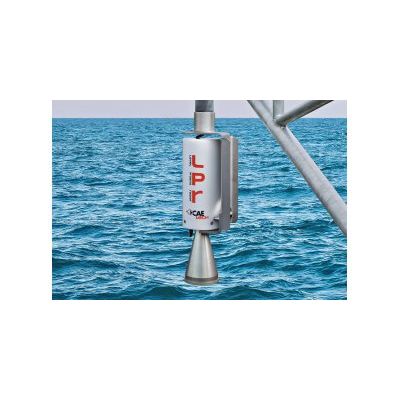
Model LPR W -Radar Wave Measurement Sensor
Wave and tide sensor based on radar technology entirely designed and manufactured in Italy. Thanks to its high sampling rate, up to 4 times per second, LPR W is suitable to detect many typical measures of marine science. Accuracy and performance are unaffected by changes in water density and atmospheric conditions, it provides accurate measurements in all weather conditions, with a measurement accuracy of ±1 cm up to 35 metres away.
LPR W is provided together with a practical configuration software for PC or tablet, thanks to this interface it is possible to identify and isolate, with the aid of a graph, any obstacles in the measurement area (pillars, boulders, containment structures, etc.) that are not the actual target to be measured.
LPR W is characterised by a reduced measuring cone, low power consumption, compact design and absence of parts immersed in water. Versatile and simple to install it has no mechanical moving parts and is therefore extremely robust , moreover it contains diagnostic sensors to verify the quality of the measurement acquired, the correct inclination of the instrument and the possible overheating.
- Connection with Data-logger RS-485 implementing SDI-12 protocol / 4-20 mA
- Dimensions Height: 34 cm, Diameter: 9 cm
- Precisione ± 1 cm up to35 m
- Measurement Range 1 ÷ 35 m
- Consumo @12.5V 50mA (mean during measurement, always on)
- Output Average height of individual waves, average height of the highest 1/3rd waves, average period of the highest 1/3rd waves, highest wave, average period of highest wave.
- Measuring Principle Radar technology for distance measurement
- Min. Resolution 1 cm
Mechanical robustness is guaranteed by:
- the attention to detail, starting with the design phase;
- encoded, tracked and certified production processes;
- the use of high quality materials;
- the experience and training of production engineers.
ZBT allows the risk of sudden failure and loss of data to be minimised, by using:
- redundant elements, which make sure that, if an element breaks, the product sends an alert while operating normally, giving time to intervene with the replacement without losing any data;
- diagnostic sensors of various types, such as the ones for the verification of:
- the correct inclination of the product,
- the quality of the acquired measurement,
- the value of the voltage input,
- the status of inputs and outputs,
- the conditions of the internal temperature,
- the reliability of the RF link between all devices,
- etc.