


- Home
- Companies
- C-Green AB
- Products
- Model OxyPower HTC - Convert Wet ...
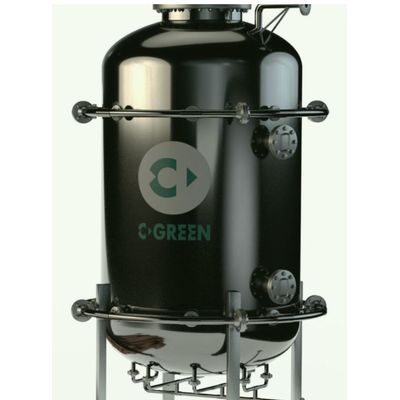
Model OxyPower HTC -Convert Wet Biowaste Technology
A unique patented combination of wet oxidation and hydrothermal carbonization (HTC) for converting wet biowaste into useful products. OxyPower HTC™ combines two established technologies: hydrothermal carbonization (HTC) and wet oxidation, with a compact industrial design. It’s an ideal solution for wet biowaste handling.
Advanced wet oxidation technology creates the heat energy required by the HTC process. In fact, the wet oxidation process is so powerful it can generate excess heat for auxiliary use.
The inert hydrochar produced by OxyPower HTC™ can be used as both a biofuel or as a soil improvement product. Or simply stored for future use.
OxyPower HTC™ simplifies both nitrogen and phosphorus recovery. Nitrogen is extracted from the nitrogen-rich process separated water, and phosphorus is recovered from ash after the incineration of the hydrochar.
Modern wastewater treatment plants aerate the incoming water causing oxidation, which helps break down biological material, a kind of slow wet oxidation. OxyPower HTC™ applies a very intensive wet oxidation process. This is achieved at a temperature of about 230 °C, which significantly accelerates the oxidation process. The resulting reactions produce heat, which is then used to run the entire OxyPower HTC™ process.
The OxyPower HTC™ process treats sludge in an HTC reactor for one hour at about 200 °C. An aqueous phase is formed containing inorganic and organic water soluble components and a slurry phase containing particles of hydrochar. The organic content in the aqueous phase is then wet oxidized under pressure at 230 °C, degrading it into CO2, water, and easily biodegradable organic acids. The resulting chemical reactions release heat, and steam is formed as the pressure is lowered. The steam is recycled and injected at the beginning of the process to heat the sludge before it is fed into the HTC reactor, thus eliminating the need for added external heat.
Vent gases from the process are treated in three steps:
-
Condensation with water
-
Scrubbing with alkaline water
-
Activated carbon treatment
Water separated from the sludge is sent back to the wastewater treatment plant. If the plant has biogas production, it is possible to increase the production with the separated water.