


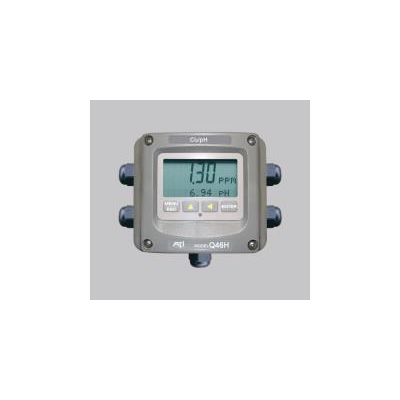
Model Q45H/62-63 -Residual Chlorine Monitor
ATI`s Chlorine Monitor is an upgraded version of our proven Q45H system for continuous water quality monitoring of free or combined chlorine. Monitor capabilities have been expanded to include options for a 3rd analog output or for adding additional low power relay outputs. Digital communication options for Profibus DP, Modbus RTU or Ethernet IP have been added, as well.
Free or Combined Chlorine
Q46H Monitors are factory set for either Free or Combined Chlorine measurement, but can easily be converted from one to the other in the field.
Reagent-less operation and low parts cost makes the Q46H your best choice for chlorine monitoring applications in potable water, wastewater, cooling water, or high purity water systems.
Automatic pH Compensation
For free chlorine monitoring under widely varying pH conditions, automatic pH compensation may be added to maintain the highest measurement accuracy at pH levels up to 9.5.
Dual Chlorine/pH Monitoring
Even when pH correction is not required, adding a pH sensor to the system converts the monitor to a dual analyzer, providing 4-20 mA outputs for both chlorine and pH.
Flexibility
Programmable range options from 0-200 PPB up to 0-200 PPM provide maximum application flexibility.
AC or DC Power Options
Power options include universal 90-260 VAC or 12-24 VDC.
Analog Output Options
Two isolated 4-20 mA outputs are standard, with an option for a third output if required. Default setting provides analog outputs for chlorine and pH.
PID Output
Standard PID control function assignable to one analog output.
Digital Communications
Available in either Profibus-DP, Modbus-RTU or Ethernet-IP.
Relay Outputs
Three SPDT relays are standard, with relay functions programmable for alarm, control, or trouble indication. Three additional low power relays available as an option.
Flexible Mounting
NEMA 4X (IP-66) enclosure is suitable for wall, pipe, or panel mounting.
Clear Display
Back-lit large LCD display provides clear visibility in any lighting conditions. A scrolling second line on the display provides additional information and programming prompts.