


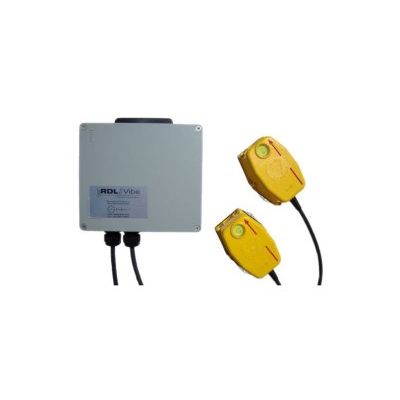
Model RDL//Vibe -Remote Building Vibration Monitoring System
A building’s response to ground-borne vibration is affected by various different factors and while a concern doesn’t always mean that there’s potential for damage, without an auditable trail of vibration data it can be difficult to link damage with a particular cause. A building vibration monitoring system such as the RDL//Vibe can monitor vibration levels and record events in high resolution while providing instant email and SMS alerts when vibration levels meet geophone (alarm) thresholds. The RDL//Vibe is a robust self powered remote vibration monitoring system ideal for monitoring vibration levels surrounding buildings that arise from construction activities such as piling, demolition, blasting and other works that generate ground vibrations.
- Parameters measured: Peak Particle Velocity (PPV), acceleration, and displacement
- Trigger levels: minimum 0.18mm/s and maximum 43.4mm/s
- Frequency range: 4.5Hz to 500Hz
- Low frequency response: 0.3Hz (with alternative geophone)
- Operating temperature: -5°C to +60°C
- Dimensions: 178 x 156 x 75 mm
- Casing: IP66 die cast aluminium
- Battery power: 2 x Lithium D Cell
RDL//Vibe features and benefits
Whether you are a vibration monitoring consultant, site or project manager, or otherwise involved in civil engineering works.... The RDL//Vibe building vibration monitoring system can be used to: ensure vibration levels do not cause damage to property, prevent annoyance to people and demonstrate compliance with tender requirements and National or local authority standards.
- Manage system settings online via the CDLSmartHub
- Manage alarm thresholds online via the CDLSmartHub
- Receive email and SMS alerts when vibration levels reach alarm thresholds
- Input for up to two tri-axial geophone sensors
- Event log of all alarms, logins, settings changes and unit power ups
- Average battery life 1-2 months with upto 1 year battery life when using low sampling and reporting frequencies
- Effortlessly easy to install
- Reduce the need to visit site by managing and monitoring data online
- Increased due dilligence with independant uneditable storage of data
- Every security measure taken to protect your data
Construction vibration monitoring
When carrying out construction works which may produce vibration, all potential receptors must be considered, with particular attention paid to occupiers and users of buildings, hospitals or laboratories, as well as cosmetic or structural damage to buildings or heritage sites.
Companies are already requested to take care planning the sequence of works in order to minimise the transfer of vibration to neighbouring properties, and in some cases project managers are instructed to monitor ground borne vibrations, react and adjust work methods to ensure vibration levels are kept below specific levels.
As available space becomes tighter it will be imperative to protect surrounding properties from the effects of excessive vibration during such works, particularly in cities across the UK.
Piles are the permanent foundation support to so many different structures throughout the UK, so it is of great importance to know the likelihood of disruption that could be caused through installing piles in order to minimise or alleviate it altogether. An increasingly important aspect of project management during construction work, is to understand the impact of ground-borne vibration, on the surrounding community.
Most susceptible to damage from ground vibrations are fragile and historic buildings. A building’s response to ground-borne vibration is affected by various different factors and while a concern doesn’t always mean that there’s potential for damage, without an auditable trail of vibration data it can be difficult to link damage with a particular cause.
Demolition vibration monitoring
As available space becomes tighter it will be imperative to protect surrounding properties from the effects of excessive vibration levels arising from demolition works, particularly in cities, as well as on sites near historic building and sensitive structures such as railway viaducts, railway lines, hospitals, server rooms, electrical sub stations and gas mains.