


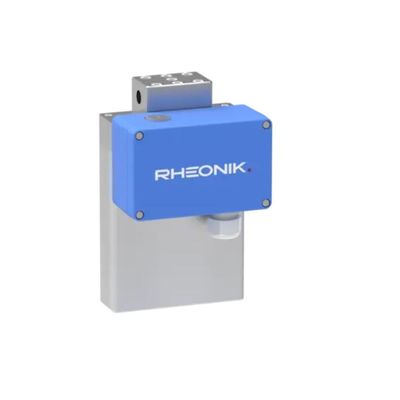
Model RHM 015 -Flow Sensor
- Range: 0.002 kg/min up to 1.2 kg/min
- Pressure: up to 1481 bar (21480 psi)
- Temperature: -196°C (-321°F) up to +210°C (410°F)
- Accuracy: 0.1 % of rate
- Materials: SS 316L / SS 316Ti, Alloy C22 – 2.4602, Super Duplex – 1.4410, Sandvik HP160
- Process Connection: ¼" up to 1"
Flow Measurement Uncertainty
Selected Sensors down to ±0.05 % ¹ of rate (Gold Line)
Standard Sensors down to ±0.15 % ² of rate
Flow Measurement Repeatability
Down to ±0.05 % of rate
Temperature Measurement
Better than ±1 °C
Density Calibration (Liquid)
Selected Sensors down to ±0.0005 kg/liter (Gold Line)
Standard Sensors down to ±0.0035 kg/liter
The turn down capability from Q??? of the flow sensor is driven mainly by its zero point stability. At the very low end of the measuring range the uncertainty (u) is dominated by zero point stability. The zero point stability of a standard sensor is: 0.000036 kg/min (0.000079 lbs/min). Zero point stability of a Gold Line sensor is 0.000019 kg/min (0.000042 lbs/min).
For flow Q ≥ ZP stability / (Base Calibration uncertainty/100) → u = calibration uncertainty
For flow Q < ZP stability / (Base Calibration uncertainty/100) → u = (zero stability/Q) * 100
-
If sensors are not zeroed at operating conditions, minor additional uncertainties can arise from elevated temperatures and pressures: ±0.00308 % of maximum flow per °C and ±0.0208 % of maximum flow per bar.
-
Process temperature effect on density: additional uncertainty of ±0.000641 g/cm³ per °C difference from calibration temperature with standard density calibration and of ±0.000073 g/cm³ per °C difference from calibration temperature with enhanced density calibration. This effect can be mitigated by a simple field density adjustment at operating conditions.
-
Process pressure effect on mass flow: The effect of pressure on flow measurement is 0.001 % of rate per bar. Compensation is possible by pressure sensor input (analog input or digital write) or manual value entry into the transmitter.
-
Process pressure effect on density: The effect of pressure on density measurement is 0.00012 g/cm³ per bar. Compensation is possible by pressure sensor input (analog input or digital write) or manual value entry into the transmitter.
Premium Plus, Ultimate, Low Flow and Enhanced Density Calibration come with Gold Line sensors and are not available in all materials, pressure and temperature ranges.
Reference conditions: 18-24°C Water @ 1-3 bar; Gas (Natural gas) 35-100 bar.
The maximum pressure (p???) of a sensor is determined by its lowest rated part. The lowest rated part can be either the measurement tube (p??? indicated below), the connection block/manifold (p??? indicated in the mechanical construction section) or the process connection (for p??? see published standards or manufacturer information).