


- Home
- Companies
- CFP Company
- Products
- Model RTLC2419 - Radioactivity TLC ...
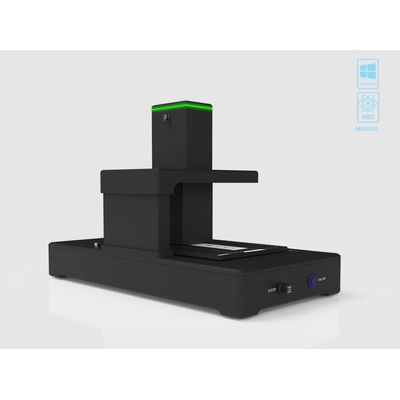
Model RTLC2419 -Radioactivity TLC Scanner
- Extremely high counting rate
- One trace scan 25mm x 200mm
- Fast, automated and reliable scans
- High sensitivity for all radioisotopes
- Optional beta probe for PET applications
- Variable scan speeds from 0.1 - 60 (mm/sec)
- Very high counting rate and dead time correction
- Spectroscopic analysis of radiopharmaceutical purity
- Full detector and data acquisition control via application software
- Performs thin-layer Chromatography (TLC) using a high-resolution NaI detector
- Daily quality control of radiopharmaceuticals used in nuclear medicine procedures
- Durable and versatile
- Splash resistant design
- Wide temperature range
- Ready for field operation
- Easy system set-up and maintenance
- Continuous operation under severe environmental condition
- Robust and suitable for use in challenging conditions
- Easy to use system with maximum flexibility and automatic positioning system
- Integrated digital MCA with 4096 channel resolution and automatic decay correction and peak integration
- Supports all data extraction and reanalysis of stored data
The standard software provides a graphical user interface for TLC scan, gamma-ray spectroscopy, detector control, data acquisition, quality assurance (QA) and database management. The provided factory programmed protocols may be supplemented by user defined protocols. The protocols provide automatic control of the detector scan, the acquisition as well as graphical display and analysis. QA is assured by the quality control procedure and trending analysis of the QA data as a function of time. The database option supports the extraction and re-analysis of all stored data. Various procedures needed for radio chromatography are implemented in the software of RTLC2419. The chromatography procedure starts with definition of “Drop Point” and “Front End” where the user can define the starting and end of chromatography. User can also define the “Time” for the whole test and the “Repeat” number of test. Together with these information, the user provides various information that will be printed in the final report and will be used to identify the person who perform the test and its exact date and time. After this initialization setting, the chromatography test will be started and in the “Time” parameter defined by the user, the test will end. By finishing the scan, various features for the device will be activated. The user can define a specific energy range and the device will immediately visualize the chromatogram for the corresponding range. On the other hand, the user can also define an interval along the test length and software will immediately generate the spectrum corresponding to that interval. Various smoothing operations for both chromatogram and spectrum are applicable in the software. For chromatographic analysis, the user can easily define “Radiopharmaceutical”, “impurity” and “Background” regions and then software will perform the analysis and show the result in the table placed on the upper right corner of the software. The report generated by the user present a summary result of the test where analysis result table, whole spectrum and chromatogram are displayed. Also the color of final report can also be customized based on the user preferences. Altogether RTLC2419 is a total solution for radio chromatography tests which provide the user with various analysis setting parameters, data visualization procedures and reports.
|
Input(s) |
|
Power |
|
48V (1.25A) AC to DC adaptor |
|
LEMO PC interface |
|
DC +5V LEMO 5 pin (200mA) for PC communication |
|
Output(s) |
|
No output signal |
|
Control(s) |
|
knob |
|
This knob provides the user with manual control over the device slider. |
|
Power Push button |
|
Push to turn device ON and hold for 3 seconds to turn device OFF (long press) While device ON push key to change mode (short press) |
|
LEMO port |
|
Setting configuration via LEMO 5 pin (A), USB (B) cable (set and read all data) |
|
Indicator(s) |
|
No indicator |
|
Performance |
|
Speed |
|
0.1 – 60mm/sec |
|
Travel length |
|
200mm |
|
Strip size |
|
25mm x 200mm |
|
Collimators |
|
Type1: For NaI(Tl) Detector (X and Gamma) |
|
Type2: For Plastic Detector (Beta) |
|
Detector |
|
NaI(Tl) |
|
1” x 1” |
|
PVT( optional) |
|
0.25mm |
|
Data Acquisition and Analysis |
|
Processor |
|
FPGA technology with Arm9, 32 bit 200MHz |
|
OS |
|
Built in Windows 7 or higher versions |
|
Software |
|
RTLC2419 (SOFTWARE) |
|
Measurement/Spectrum |
|
High Voltage |
|
0 - 1500V (DAC 12bit) 0.2mA |
|
Energy channel (selective by admin) |
|
From 0 to 1024keV |
|
From 0 to 2048keV |
|
From 0 to 3072keV |
|
From 0 to 4096keV |
|
Energy calibration |
|
Non-linear empirical function or linear Calibration (polynomial fit) |
|
ROI selection |
|
Radiopharmaceuticals (arbitrary number of RoI) |
|
Impurity (arbitrary number of RoI) |
|
Background (one RoI) |
|
ADC |
|
Channels |
|
12bit in 4096CH @120Mhz FRQ |
|
Conversion time |
|
200nsec with 8.3nsec time interval |
|
Digital Signal Processing |
|
12-bit and 120MHz ADC |
|
Charge sensitive preamplifier gain:10 – 150mV/pC (selectable) |
|
Amplifier coarse gain: (x1 to 150x) in 15 step |
|
Amplifier fine gain: (0 - 2x) in 65536 step |
|
Integration time filter for the energy calculation with software adjustable rise time in the range 0 to 0.546ms @80Mhz in 0-65536 step |
|
Trigger threshold software adjustment (0 to 100% scale) in 1024 step |
|
Software fine tuning of the Pole-Zero cancellation |
|
Software gain stabilization |
|
Pile-up rejection and live time correction |
|
Baseline restorer with programmable averaging |