

- Home
- Companies
- Precision Coating Company, Inc
- Products
- Model Type III - Military Standards - ...
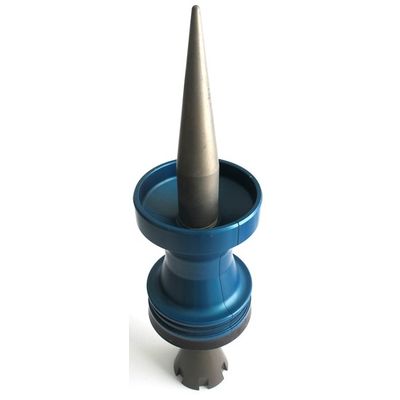
Model Type III - Military Standards -Hardcoat Anodizing
Type III aluminum anodizing, also called hard coat anodizing or hard anodizing, is used to increase the wear and corrosion resistance, increase the surface hardness, and improve the thermal and dialectical properties of treated aluminum objects. The ability to retain lubricants, PTFE coatings (like Sanford Hardlube™), also improves with Type III anodizing.
Hard coat anodizing increases the thickness of the naturally occurring oxide layer on aluminum surfaces. Natural oxide layers are generally 2 to 3 nanometers thick—with Type III anodizing, this layer can be increased to or above 50 μm* (0.002”). Properly applied hard anodic coatings create a very regular, uniform layer across the entire surface of the treated object.
Type III anodizing is an abbreviation derived from the military standard Mil-A-8625 Type III category.
* μm = micrometer (1000x the length of a nanometer)
Conventional Type III aluminum anodizing uses a high voltage process (up to 100V) to create the oxide layer. The aluminum object itself serves as the positive electrode (or anode, from which the term “anodizing” originates) in the process. The formation of the oxide film take place by the migration of Al3+ ions away from the metal towards the electrolyte interface, while simultaneously O2- ions from the electrolyte move in the opposite directions.
The acid solution used in hard anodizing is concentrated at around 200g/liter. The voltage used starts at 25V DC and increases to 60-100V as the process continues.
Conventional Type III coatings can be sealed by hydrothermal or precipitation means, or left unsealed. Choice of seal depends on the object’s intended purpose and use.
An alternative Hard Coat method that achieves superior performance properties is the Sanford Low Voltage rectification process where an AC current overlays DC current and leads to lower resistance at the anode surface. This produces a more uniform coating with a number of performance improvements. Sanford Low Voltage Processes include: PLUS, QUANTUM, SALVAGE, and MICRALOX.
Conventional Aluminum Hard Coat is used for applications requiring:
- High corrosion resistance is required.
- High abrasion resistance is required
- Dielectric barrier usually > 1000 < 2000 Volt DC.
- High bond strength with polymeric coatings and adhesives.
- Mil-A-8625 Type III, Class 1 & 2
- MIL-STD 171 7.5.1
- MIL-STD 171 7.5.2
- AMS 2468 & 2469
- BS 5599
- BS EN 2536
- ASTM B 580 Type A
- BAC 5821
- PS 13208
- PS 13201
- PS 13021.1
- HP 4-79