

- Home
- Companies
- Phornano Holding GmbH
- Products
- Nano Gold - Monodisperse
Nano Gold - Monodisperse
HighQuant monodisperse gold nanoparticles are manufactured with highest precision, free from agglomeration, ready to unfold their full potential in your research, development, and use in industrial scale in your demanding applications. Each single batch of HighQuant Gold nanoparticles is precisely characterized using UV/VIS spectroscopy, regularly calibrated with Transmission Electron Microscopy (TEM), dynamic light scattering (DLS, particle size analysis) and/or Zeta potential measurements.
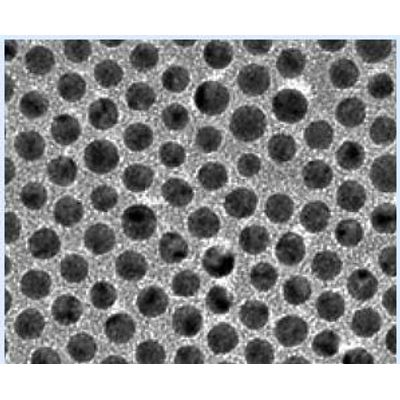
Due to the quantum size and surface e?ect, noble metal nanoparticles have optical, electromagnetic and chemical properties that are different from those of their bulk-material counterparts. Transmission electron microscopy (TEM) image of spherical gold nanoparticles is shown in Figure 1. They show high efficiency in absorbing and scattering light with their absorbance spectrum tunable by their shape and size.
Nobel metal nanoparticles show enhanced physical properties, Local Surface Plasmon Resonance (LSPR) effects, which result in enhanced absorption, high chemical stability, catalytic activity and nonlinear optical effects as a result. These properties make them of value in microelectronics, sensors utilizing their LSPR properties, in biomedical imaging and diagnostics at the cellular and molecular level as well as in therapy in pharmaceutical applications and in cosmetics.
Due to the quantum size and surface efect, noble metal nanoparticles have optical, electromagnetic and chemical properties that are different from those of their bulk-material counterparts. Transmission electron microscopy (TEM) image of spherical gold nanoparticles is shown in Figure 1. They show high efficiency in absorbing and scattering light with their absorbance spectrum tunable by their shape and size.
Nobel metal nanoparticles show enhanced physical properties, Local Surface Plasmon Resonance (LSPR) effects, which result in enhanced absorption, high chemical stability, catalytic activity and nonlinear optical effects as a result. These properties make them of value in microelectronics, sensors utilizing their LSPR properties, in biomedical imaging and diagnostics at the cellular and molecular level as well as in therapy in pharmaceutical applications and in cosmetics.
Due to the quantum size and surface e?ect, noble metal nanoparticles have optical, electromagnetic and chemical properties that are different from those of their bulk-material counterparts. Transmission electron microscopy (TEM) image of spherical gold nanoparticles is shown in Figure 1. They show high efficiency in absorbing and scattering light with their absorbance spectrum tunable by their shape and size.
Nobel metal nanoparticles show enhanced physical properties, Local Surface Plasmon Resonance (LSPR) effects, which result in enhanced absorption, high chemical stability, catalytic activity and nonlinear optical effects as a result. These properties make them of value in microelectronics, sensors utilizing their LSPR properties, in biomedical imaging and diagnostics at the cellular and molecular level as well as in therapy in pharmaceutical applications and in cosmetics.
Gold nanoparticles are being used in a large variety of technologies and incorporated into applications ranging from consumer products to high end biomedical applications that take advantage of their desirable optical and electronic properties.
- Diagnostic Applications: Gold nanoparticles are used in bio-imaging, biosensors and as biological tags for quantitative detection.
- Conductive Applications: Gold nanoparticles are used in conductive inks and integrated into composites to enhance thermal and electrical properties.
- Optical Applications: Gold nanoparticles are used to efficiently harvest light and for enhancement of optical properties including metal-enhanced fluorescence (MEF) and surface-enhanced Raman scattering (SERS).