


- Home
- Companies
- Allied Environmental Technologies, Inc.
- Products
- Allied - Multi Stage Collecto (MSC)
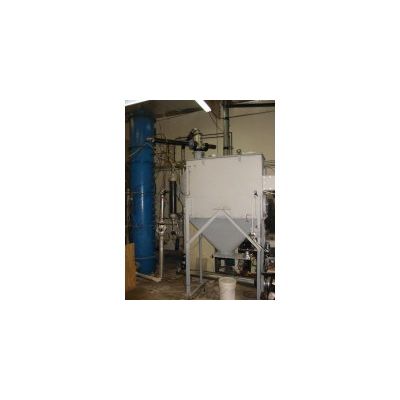
Allied - Multi Stage Collecto (MSC)
Allied Environmental Technologies, Inc. has a dedicated research and development group working within its key areas of expertise. R&D efforts aimed at finding practical solutions to air pollution, mass and heat transfer, fluid dynamics, processes in single and multi-phase fluid flows, and applied energy systems. Available control methods are evaluated and applied were appropriate. When necessary, new technologies are developed through in-depth analysis, followed by bench and pilot scale experimentation.
ALLIED develops and commercializes innovative new ideas using our in-house specialists and bringing together consultants, engineers, and scientists from key partners throughout the world.
Allied Environmental Technologies, Inc. developed and perfected numerous computer models to assist in the Electrostatic Precipitators performance evaluation, fly ash resistivity and available methods of its modification modeling. The company`s array of expertise also includes Computations Fluid Dynamics (CFD) modeling to analyze flue gas mixing, chemical reaction kinetics, mass and heat transfer. This tool permits more accurate prediction of system performance and improves equipment design.
Combining our expertise and knowledge of air emissions control technology, Allied Environmental Technologies, Inc. brings state-of-the-art control techniques and proprietary technologies to help successfully solve client`s problems.
Specifically, we offer expertise of many years working with particulate equipment design, performance analyses, and its improvement. Our expertise is based on years working with particulate equipment design, performance analyses, and its improvement. Selected examples of the projects handled in the past are listed below:
- Particulate control devices specification, selection, design and performance evaluation
- Particulate control devices evaluation in conjunction with FGD systems design and operation
- ESP/Fabric Filter - Dry FGD system pilot for 500 MW boiler unit design and operation
- ESP computer modeling, performance evaluation and guarantees development and evaluation
- Computer modeling of fly ash resistivity and its modification
- Development of novel processes and methods for flue gas conditioning (FGC)
- Development of innovative ways to automatically control FGC processes
- Design and operation of the full-scale demonstration system for a fabric filter with dual (SO3 and NH3) flue gas conditioning system evaluation.
- Design, manufacturing, installation supervision, start-up, and shakedown of the full-scale SNCR systems on urea.
- Design, manufacturing, installation supervision, start-up, and shakedown of the fully automated mini-plant to manufacture the urea solution.
It is well known in the art how to build and use electrostatic precipitators. It is also known in the art how to build and use a barrier filter such as a baghouse. Further, it is known in the art how to charge particles and that charged particles may be collected in a barrier filter with lower pressure drop and emissions than uncharged particles collected for the same filtration velocity.
The invention consists of a new method and design for a novel multi-stage collector for collecting dust, fume, etc. for industrial gases, that is, basically, independent of electrical resistivity, thus it is especially beneficial when electrical resistivity of such dust or fume as precipitated, exceeds 1011 Ohm-cm or is extremely low, for example less than 104 Ohm-cm. Furthermore, this design will be particularly advantageous when the material to be collected consists mostly of a sub-micron dust and/or fume (PM 2.5). It also could be easily integrated with various catalysts for multitude of the gaseous pollutants collection.
The novel Multi-Stage Collector (MSCTM) design is motivated by a potential ability of the two-stage to collect and agglomerate small particulate matter and of the single-stage to collect and retain "blowoff" dust, which is lost from the "conventional" two-stage design. Furthermore, it also incorporates an additional collector stage by screening the gas exiting the collector through the barrier collector zone. This arrangement assures that essentially all dust (either uncollected in electrostatic collection zones or being re-entrained in the gas stream during the rapping and/or bag-cleaning steps) would be detained in this final stage.
The MSCTM design is free of the detrimental characteristic of the single-, and two-stage electrostatic precipitators, as well as known electrostatically enhanced barrier filters design:
- it continuously offers ample supply of the ions for aerosol particles charging,
- by a virtue of the unique design offers improved collection efficiency, and
- it also incorporates an additional collector stage by screening the gas exiting the collector through the barrier collector zone
Specifically, the MSCTM could find its use within the following areas/applications:
- Super clean exhaust gases: “Vision 21”
- Integrated Gasification Combined Cycle (IGCC): super-clean de-dusting process (synthetic) gases from the gasification equipment prior to the introduction into the combustion turbine
- Industrial mineral processing industries:
- In-process capture of the expensive product material and return to the process, i.e. metals, rock-dust, gold, etc.
- Post-processing super-clean de-dusting prior to exhaust to the atmosphere.
- Multi-pollutant applications, i.e. SOx, NOx, Hg, etc. via integrating (or impregnating) catalyst materials within the barrier filter.
- The MSC design is superbly compact and warrants very high efficiencies in the sib-micron/ultra-fine particulate range. Hence, it may be also suitable for the gas turbine inlet air cleaning.
Finally, by integrating one of the stages (barrier) with one or several catalytical materials, this novel (MSCTM) may become an “ultimate” emissions control apparatus.