


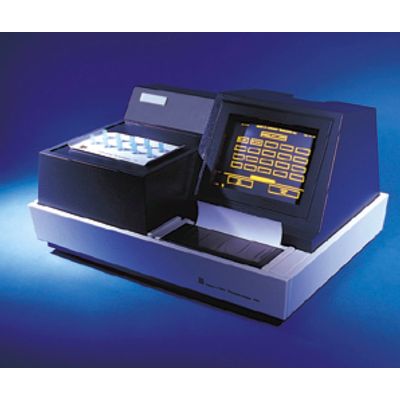
Genesys - Model 5000 Series -Multi-Well Gamma Counters (Remanufactured)
The Corner Stone of RIA, The original 25 well. The most feature packed gamma counter in the world. After 35+ years of business, we get a lot of repeat customers. Often they trade in old counters, or trade up for a larger model. We don’t sell used equipment however, from time to time we have re-manufactured and refurbished counters for sale.
Data Reduction
The GENESYS 5000 Series gamma counters contain advanced data reduction features suitable for calculating all versions of RIA, IRMA, Ratio and Screening assays. With the flexibility to independently choose curvefit, response variable (transformation) and graph paper, the GENESYS 5000 gives you the power to adequately handle the wide range of radioimmunoiassays available for clinical and research applications; from the routine through the esoteric.
The range of popular curvefits include: point to point, straight line, weighted straight line, cubic spline, universal and four parameter logistic (4PL).
Response variables include: %B/TC, %B/B0, CPM, TC/B, B0/B, 1/CPM, CPM/(standard #), %CPM/ (High Standard), CPM/(TC-CPM) and (TC-CPM)/CPM.
Standard curve axes choices are: Linear-Linear, semi-Log, Log-Log, Logit-Log, Linear-Log and Log-Linear.
With this variety of choices, even the most demanding applications can be met with ease. A brief description of each curvefit algorithm follows:
Point to Point:
This curve fit connects adjacent standard points with a straight line. This is a “connect the dots” approach, and is quite commonly used in older software packages and for connecting particularly difficult data. This curve fit is best used when there are many standard points within the curve, or when there is a very sharp change in slope. This curvefit minimizes curvature errors.
Straight line:
This curvefit utilizes a single, straight line to fit all standard points within the curve. This fit, therefore, requires that all points on the curve be first “linearized”. This is most often
accomplished by using a Logit-Log or/Bound type of transformation. By first linearizing the data, fitting errors will be minimized.
Weighted Straight Line:
This curvefit begins as a straight line, then adds “weighting factors” as needed. These weighting factors are particularly helpful to minimize the effect of stray points which are further from the most stable portion of the curve (mid dose). The weighting factor changes the slope of the curve to maximize the influence on the mid-dose area of the curve.
Cubic Spline:
The Cubic Spline is actually not a single curve, but rather a series of curvilinear segments, which are joined together at “knots”. These knots are the standard points. Therefore, the overall curve must pass through the mean of each of the standard points exactly. The cubic spline fit is very commonly used in IRMA assays, where a larger number of standard points is typical. Due to the nature of the cubic spline equation, the standard curve must contain at least 4 points in order to fill the equation.
Universal Curve:
The Universal Curve found in the Genesys 5000 series gamma counter is an extension of the basic cubic spline with some very unique differences. The Universal Curve utilizes the statistical uncertainties of each standard point in the curve to allow a “range” into which to fit the curve, rather than force it through the mean.
Because of this statistical “smoothing” function, the Universal Curve has the ability to fulfill a much wider range of data than the standard cubic spline. The Universal Curve can be specifically useful in IRMA assays which involve very low count standard points at low dose. Since the uncertainty is greatest near the extremities of the curve and particularly the area of lowest count rate, this region logically should impact the shape of the overall curve the least. Thus, the Universal Curve compensates for these inaccuracies by extending the range through which the curve is fit, thereby greatly improving the overall performance of the assay as a whole.
Four Parameter Logistic:
The four parameter logistic curve fit is based upon the “All Fit” program originally developed at NIH. It is basically an extension of the two parameter Logit-Log method. By its nature, the 4PL, like the cubic spline must have at least four standard points in order to plot a curve. The four parameter is the most “robust” of all the curve fits, and is the most widely suitable for a variety of applications from sigmoidal or J-shaped RIA’s to high sensitivity IRMAs.
The nature of the 4PL equation requires that the GENESYS 5000 SERIES gamma counters perform many iterations of highly complex calculations in order to achieve the best fitting curve. It is therefore common to wait A second or two for the curve to calculate.
A brief summary of the curvefits and the best instances to use them:
ISOTOPE SELECTION
While I125 is certainly the most commonly used isotope in the clinical laboratory, other applications and uses often arise. In Nuclear Medicine facilities, research laboratories, extended clinical and esoteric testing often require the use of different isotopes. TheGENESYS 5000 Series gamma counters are designed to effectively and efficiently count a wide variety of isotopes, vastly extending the useful range beyond routine RIA.
The GENESYS 5000 Series gamma counters utilize a NaI(tl) crystal detector. These detectors incorporate a monoline well-type configuration, ensuring superior geometry and counting efficiency over through-hole styles. The well is bored deeply to accommodate varying sample sizes with minimal loss of efficiency due to “angle of incidence”.
Additionally, each GENESYS detector contains extra crystal mass at the bottom of the detector to allow better “stopping power” for higher energy isotopes. Greater efficiency is achieved than with traditional small diameter detectors. Two stage lead shielding provides excellent shielding between detectors, with an additional heavy lead plates surrounding the entire detector array. This provides very low background radiation levels, for improved signal to noise ratio and superior counting results.
For assays involving the use of more than one isotope simultaneously (i.e. B12_Folate), The GENESYS 5000 Series gamma counters employ simultaneous dual label counting. Simply put, both isotopes are counted at the same time, spilldown between spectra is automatically eliminated.
For situations involving higher energy isotopes (i.e. Cr51, In111, Fe59, etc.), a feature
known as crossover correction is employed, thereby eliminating the effects in adjacent detectors.
One important application for this high energy capability is in the area of P.E.T. counting. GENESYS 5000 Series gamma counters can achieve a counting efficiency of 47% for Na22 with the proper window settings. The GENESYS 5000 Series gamma counters has a counting range from 1 -1000 KEV.
STANDARD CURVE TEMPLATE
THIS RUN WAS SAVED FROM AN UNNECESSARY REPEAT WITH THE USE OF THE TEMPLATE!
Look at standard #5. It is denoted with a square box as opposed to a dot. Anytime a Template value is used in the standard curve, that point appears as a large open box–so that it cannot be confused with a “true” point.
WHAT IS THE TEMPLATE?
The Template is comprised of stored Percent Binding values for each standard present in the curve. The values are averaged continuously, so that each run improves the precision of the Template. The Template is very useful for standard curve quality control and editing.
HOW IS THE TEMPLATE USED?
– On a comparison basis to determine for yourself the validity of the current assay’s curve. -To replace “bad” points on the current run’s curve with proven Template values.
-By setting the Template into the auto-run’s curve with proven Template values.
By basing all calculations on Percent Binding values, the Template offers an ideal solution to curve editing problems.
The Template function is unique in that it allows you to compare each individual standard against the historical values from previous complete monitoring of your assay using your own historical values not those of a manufacturer, run under special conditions.
PATIENT RESULT’S SUMMARY
The GENESYS offers the unique ability to generate Patient Summary Reports, complete with the Patient Mean for this run, Standard Deviations, and a concise summary of patients results.
Full editing of any or all patients is possible before the summary report generation. Post-processing calculations, such as dilutions, may be easily calculated. The unknown results appear on the touch screen.