


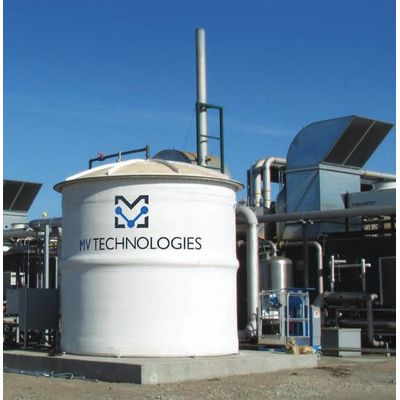
MV-Technologies - Model Plus -H2S Removal System
MV’s H2S Plus Systems are in use treating biogas streams from landfills to anaerobic digesters at farms, wastewater treatment facilities and food & beverage processing operations. MV’s systems treat 30,000 cubic feet of biogas and landfill gas/min., every day and provide low cost solutions to H2S management in natural gas production and oil refining operations.
H2SPlus Systems are designed to remove low to moderate concentrations of hydrogen sulfide (H2S) and mercaptans from gas and air streams. In addition to the removal of sulfur-containing products, the system also will remove certain biodegradable, volatile, and semi-volatile hydrocarbon odors, together with amine odors. The basic H2SPlus System is a result of over ten years of in-field application and each component is sized to meet site-specific requirements. Systems can be easily configured to adjust to future changes (+/-) in process operating parameters. Key components of an H2SPlus system are:
- Media Vessel(s) – Fiberglass or stainless steel tanks sized to accommodate flow rate and maximize media life.
- MVNets™ and Fully Removable Lid – Provide dramatically easier removal of spent media when compared to other H2S removal systems.
- BioActive Media – Proprietary enhancement for removal up to 13lbs of H2S per cubic foot.
- Recirculation System – sized to maintain optimal moisture content of the media.
- Blower – sized according to system parameters.
- Spray Nozzle – positioned inside top of lid to keep media moist.
- Sump – used to recirculate minimal amount of water required for regeneration and maintains moisture.
- Monitoring and Control System – system monitoring of temperature, sump pump, and blower controls.
Fundamental Design Considerations
There are standard inputs required to properly size an MV H2SPlus™ system:
- Typical flow rates, both maximum and average
- Inlet concentration of H2S in the ‘raw’ gas stream
- Target (treated) H2S concentration level at the outlet of the scrubber
- Pressure (psi) – If the system is operated under pressure/vacuum.
- The source of the gas / industry
- The main reason for treating the gas
- The end-use for the gas
- Geographic location
The flow rate information determines the size and number of media tanks required. Geographic location determines if the tanks need to be insulated. The concentration determines the media consumption rate and informs other elements on the design of the system. The combination of the flow rate and the concentration yields the weight of H2S to be removed per unit time. You can estimate your annual H2S treatment requirements and media consumption cost here. We also need to know the intended use of the gas after it has been scrubbed. If it is intended for pipeline application or other uses that demand strict controls over concentrations, those will influence the system design as well. Media life between replacement cycles is calculated based on the H2S concentration, total flow rates, and specific system design. The final design selection is often a trade-off between system footprint limitations and target media change cycle time.
MV’s core technology is its H2SPlus™ Systems – a proven “dry scrubber” (aka., dry chemical (absorbent) scrubber technology combined with a superior system design – informed by over ten years of in-field application to ensure maximum performance, safety and cost-effectiveness.
The H2SPlus™ System approach to dry-scrubbing uses long-proven, low-cost iron oxide coated media (iron sponge) that MV Technologies has enriched with select bacteria and complemented with a system designed to extend media life and dramatically increase ease of system use. Iron sponge has been used to remove H2S from gas streams for more than 100 years and the media is comprised of wood chips coated with iron hydroxide.
H2SPlus Systems are currently in use throughout the U.S. treating a variety of gas streams to remove H2S & mercaptans and reduce SO2.
Predictable & Consistent Performance. Guaranteed.
MV applies the best available technology to clients’ site specific conditions in order to deliver H2S removal systems at the lowest total cost of ownership with a performance guarantee to meet target outlet concentration.
H2SPlus Systems are Performance-Based.
- Operated at 100% effectiveness immediately upon startup.
- NOT susceptible to fluctuating gas conditions.
- Removes 13 lbs. of H2S per cubic foot of media.
H2SPlus Systems are guaranteed to meet target outlet concentrations, regardless of seasonal variations / fluctuations of H2S inlet ppmv. An increase in H2S concentration only affects the rate at which the media is consumed and not the performance of the system. And, at $1.31 per pound of neutralized H2S -- our enhanced iron sponge media, coupled with our engineered systems, provides the most economical dry scrubber in-market.
Importantly and unlike biological scrubbers, an H2SPlus Systems will absorb large fluctuations of incoming H2S concentrations, and continue to deliver the designed outlet condition without deviation. Therefore, if your project has a “bright-line limit” on H2S or SO2 concentrations, there is no need to worry about whether changes in feedstock, water conditions, or any other incoming variable will put you out of compliance when using the H2SPlus System.
The MV Technologies Difference
What sets H2SPlus Systems apart from other systems is the combination of biologically enhanced media with a proven system design, informed by over ten years of in-field application.
H2SPlus Systems offer:
- Flexibility & Scalability
- Consistency of Performance
- Lowest Total Cost of Operation
The key operating advantages of H2SPlus Systems are:
- Extended media life
- Minimal operator attention
- Reduced operating expense
- Dramatically increased ease of system use
At end of life, MV’s media:
- is non-hazardous
- passes the Environmental Protection Agency’s T.C.L.P test and meets O.S.H.A. definitions of a “not readily ignitable solid”
- can be composted, land-applied, or disposed of in landfills.