


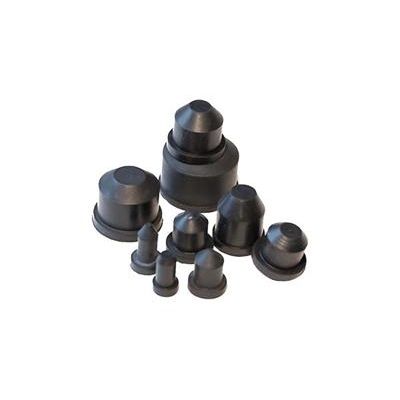
Natural Rubber Products, Materials & Applications
Natural rubber was originally derived from latex found in the sap of rubber trees. The purified form of natural rubber can also be produced synthetically. Natural rubber is an ideal polymer for dynamic or static engineering applications.
- Common Name: Natural Rubber
- ASTM D-2000 Classification: AA
- Chemical Definition: Polyisoprene
- Temperature Range
- Low Temperature Usage: -20° to -60° F | -29° to -51°C
- High Temperature Usage: Up to 175° F | Up to 80°C
- Tensile Strength
- Tensile Range (P.S.I): 500-3500
- Elongation (Max %): 700
- Durometer Range (Shore A): 20-100
- Resistance
- Abrasion Resistance: Excellent
- Tear Resistance: Excellent
- Solvent Resistance: Poor
- Oil Resistance: Poor
- Additional Properties
- Adhesion to Metals: Excellent
- Aging Weather - Sunlight: Poor
- Resilience - Rebound: Excellent
- Compression Set: Excellent
Caution: Natural Rubber is not recommended for applications where the rubber part will be exposed to ozone, oils or solvents.
Abrasion Resistance
Natural Rubber is an abrasion resistant material used in areas where other material would wear out.
Heavy Equipment Industry
- Shock mounts
- Vibration isolators
- Gaskets
- Seals
- Rolls
- Hose and tubing
Broad Chemical Compatibility
Natural rubber has been used as a versatile material in engineering for many years. It combines high tensile and tear strength with an outstanding resistance to fatigue.
To achieve the properties required for a given products, raw natural rubber can be compounded.
- Adjustable hardness from very soft to very hard
- Appearance and color ranges from translucent (soft) to black (hard)
- Can be compounded to meet nearly any mechanical requirement
- Ability to be electrically insulating or fully conductive
- Protection, insulation and sealing properties
- Absorb vibration and silence noise
- Available in any surface roughness and shape
Properties Affected by Compounds
- Hardness
- Modulus
- High Resilience
- High Damping
- Low Compression Set
- Low Creep/Relaxation
- Cross Link Density