


- Home
- Companies
- Janisch & Schulz GmbH
- Products
- Janisch Schulz - Natural Swimming Pool
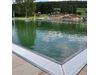
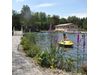
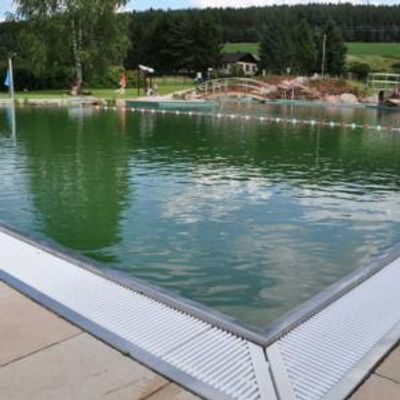
Janisch Schulz - Natural Swimming Pool
Local politicians and committed citizens have to struggle their way through this decision-making process. We, as natural pool planners, are happy to contribute to this process with our designs and cost estimates.
Many municipalities are faced with the question of what to do with their aging outdoor pools. Close or renovate? If refurbishment: Conventional or natural?
We create original designs and provide you with references. The best recommendation for a natural pool is a satisfied customer and a functioning natural adventure pool.
Just as all architecture bears the signature of its designer, design elements that we love to work with keep reappearing in our natural pools.
On the one hand, these elements have proven themselves and have been improved by us over time, such as the water bob, the wooden bridge, the entry ladders, the hand barrel or the stainless steel overflow channel. These are all elements that can be made by local craftsmen according to our plans.
On the other hand, we plan with details that we simply like such as the organically curved shorelines with embedded vegetation zones. We use local natural stone wherever possible to build jump rocks, seating areas, or slope stabilization.
imposing diving rock, 3.40 m high
small children’s pool made of natural stone mosaic from red basalt tuff with water spouting elephant
Our natural pools are created by local craftsmanship and with freely available building materials. We work unaffiliated with any of the system suppliers that are in the business. Our payment is exclusively our engineering fee.
The conversion of an outdoor swimming pool into a natural swimming pool rarely works out as a complete DIY project; more complex construction measures are usually required. However, we always design our tenders in such a way that a maximum of own contribution is possible. The main part of the work – the demolition and structural work – usually has to be put out to public tender. The partial lots for woodwork, locksmithing, plumbing and electrical work can usually be awarded on a restricted basis. As a rule, regional craftsmen are then awarded the contract.
The hour of the self-providers strikes with the organization of the outside plant. We often only invite tenders for the supply of materials. The installation is then carried out by committed citizens.
A functioning water circulation system is a prerequisite for the functionality of the natural pool. It must be ensured that floating pollutants such as pollen, dust, leaves, hair and slime are quickly removed from the pool. The water treatment is then carried out in three purification stages:
dirt and leaf trapping
Here sinking and floatable substances are retained.
planted bottom filter
The principle of the planted soil filter is similar to that of the constructed wetlands. During the flow through the filter material different cleaning processes interlock. Microorganisms settle in the soil body by themselves and decompose by their metabolism accumulating pollutants. The plants promote the living conditions for the microbiome, for example by transporting oxygen into the substrate via the roots.
regeneration pond
A regeneration pond is the essential building block in our water treatment system. It should be shallow and sun-drenched, with dense riparian and aquatic vegetation. Algae growth is also welcome here, as they perform an important function in the regeneration pond, fixing nutrients in biomass.
The regeneration pond is an essential component of water treatment.
“It speaks for the water quality
that rare newt species are also found.”
To purify the pool water, it only needs to be kept circulating and filtered through the various biological purification stages. This is done by means of pumps that are switched with a simple control system. Chemical agents and technical sand filters can be dispensed with. For example, operating costs at the Altengronau outdoor pool were reduced from €50,000 per year to €20,000 per year during the conversion to a natural pool.
Maintenance work consists mainly of horticultural care of the overgrown bottom filter and the fining pond and a cleaning of the pool in spring, when the pool water is drained. Lime should be loosened from the waterproofing tarps every 5 to 10 years. The toddler pool is to be considered a shallow water play area where toddlers can splash without having to use high volumes of water to maintain sanitation. The toddler area must be fed with potable water and draining is done through the sewer.
- Less expensive to build than other options.The construction materials are available every where and do not have to be imported.
- The technology itself is easy to maintain the operation with local personal is no problem.
- High ability to tolerate fluctuations in flow and inlet quality and high process stability (buffering effect).
- Sludge produced only by the primary treatment stage.
- High pathogen removel-appropriate for water reuse.
- Optimal aesthetic appearance.
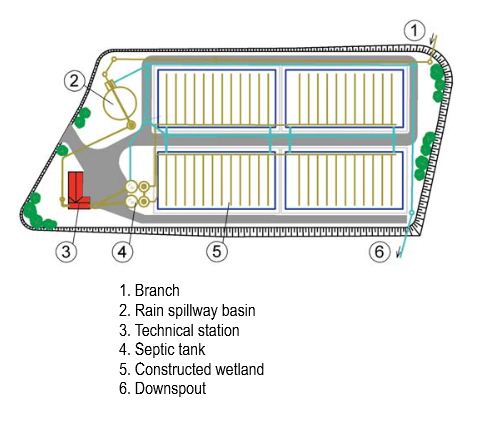
In a first process step solids are extracted from the wastewater in septic tanks. The run off is delivered by pumps or with a mechanical flush-system into the wetland field.
Depending on installation type the wastewater flows through the constructed wetland in horizontal or vertical direction.
The filter consists of sands and gravel in various granulations. A "biofilm" forms on the surface of the filtermaterial which is the medium for rapidly colonizing microorganisms.
Carbon and nitrogen in the slop serve the microbes as nutrients. They are eliminated in aerobic and anaerobic processes, while phosphates are removed by sorption.
Adapted marsh plants grow on its surface and offer a beautiful sight. The roots penetrate the gravel-sand-bedding, ventilates it and keeps it hydraulically permeable.
The effluent can be utilized for domestic and industrial use as well as for watering gardens and greens.
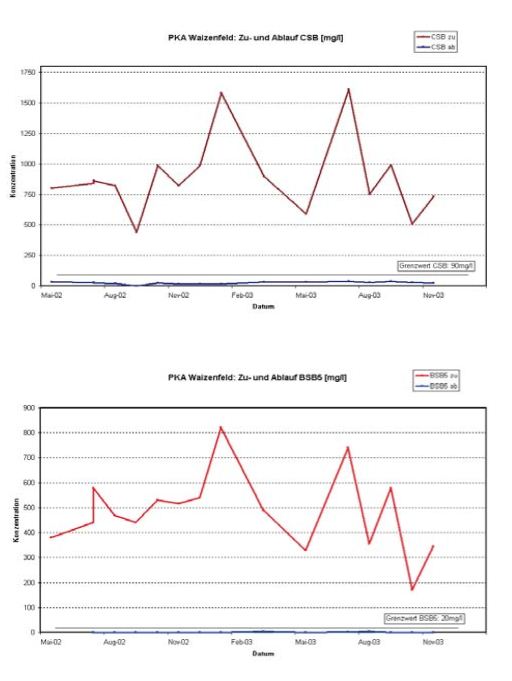
Despite fluctuating contamination (red line) properly, installed and maintained constructed wetlands can continuously match the different benchmarks like COD or BOD for example.