- Home
- Companies
- Met One Instruments Powered by Acoem
- Products
- Climatronics - Naturally Aspirated ...
Climatronics - Naturally Aspirated Shields
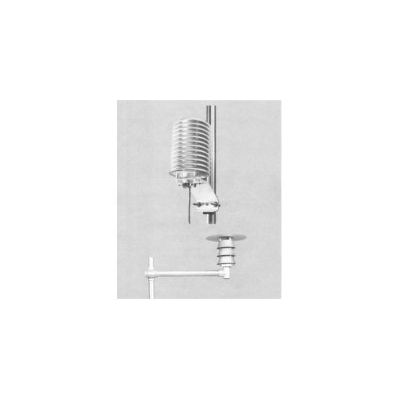
Climatronics offers three types of naturally aspirated shields. All are field proven, varying principally in price, materials, and mounting configuration. They are naturally ventilated and designed to our ambient temperature, relative humidity, and dew point temperature sensors in applications where AC power is unavailable or maximum sensor accuracy is not required. The shields may be mounted on a tower or boom with pipe size varying from %` to 2`. All feature easy access for sensor installation and servicing.
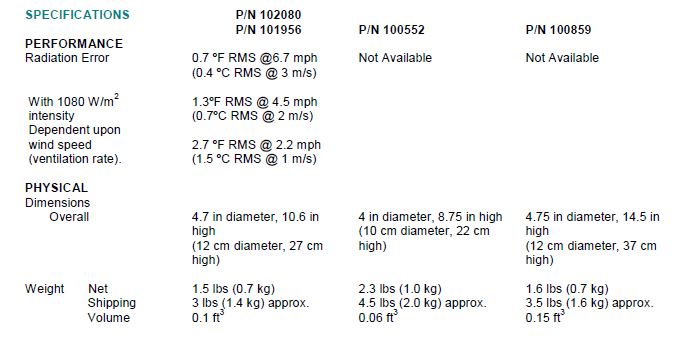
The Multi-Plate Radiation Shield, P/N 101956 and 102080, consists of twelve, white opaque molded, thermoplastic discs permitting easy air passage through the shield. This material provides high reflectivity, low thermal conductivity, and low heat retention. The unique disc profile provides positive blockage of direct and reflected solar radiation. Wind tunnel tests with maximum artificial radiation indicate that under conditions of low air movement (1m/s) the temperature sensor is maintained within 2.7 °F (1.5 °C) of ambient. This improves to 0.7 °F (0.4 °C) or less at wind speed greater than 3 m/s.
The Anodized Aluminum Shield, P/N 100552, is our most cost-effective shield designed to house Temperature Sensor, P/N 100093, and/or Relative Humidity Sensor, P/N 100098. These sensors are held inside the shield via a mount made of Delrin. The cover plate of this shield provides a convenient location for mounting any of Climatronics solar radiation sensors.
The Aluminum Dew Point Shield, P/N 100859, is designed specifically to protect the Lithium Chloride Dew Point Sensor, P/N 101197, from solar radiation and atmospheric contamination. The shield consists of a heater board assembly along with two cylindrical tubes and a baffle network. Natural aspiration of the sensor is controlled by the internal baffle network designed to avoid measurement oscillations, which may develop if the sensor is over aspirated.
- Low Cost
- Compact, Lightweight
- Maximized Radiation Protection