

Naxys - Acoustic Leak Detection (ALD)
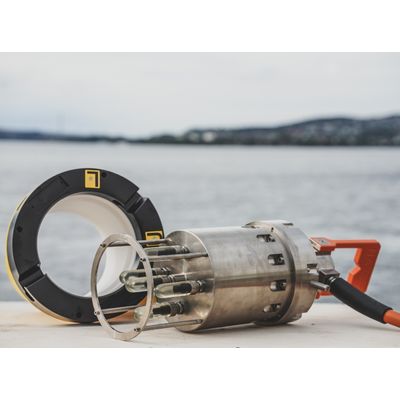
The Naxys ALD detects and localizes any leak (hydraulic, oil, MEG, water or gas) at distances up to 500 meters (depending on differential pressure, leakage rate and background noise). Providing excellent area coverage, only one ALD is required to monitor a large manifold or a cluster of wells. Since 1st version installed in 2006, more than 100 systems have been permanently deployed on the Norwegian Cont. Shelf, Gulf of Mexico and Africa. Although based on the same technology since 2006 the electronics and software has been continuously updated to minimize the risk for false positive and false negative alarms. On behalf of The Norwegian Oil and Gas Association, SINTEF Petroleum Research performed an assessment of available technologies for subsea leak detection.
- The system detects both gas and crude oil leakages very well, and is well suited for area coverage.
- Gas leakages are in general easier to detect than crude oil leakages.
- The most important parameter for detection is the pressure difference across the leakage opening, due to the creation of acoustic noise.
- If the pressure difference is above around 5 bar, leakages are easily detectable within a range of at least 10 m.
- The detection is also dependent upon the distance to the leakage and the size of the leakage opening.
- Localization of the leakage is possible.
- Other leaking fluids should also be easily detected, as long as there is a pressure difference across the leakage opening that generates sufficient acoustic noise.
The ALD is also used for Flow Induced Vibration monitoring, choke and valve monitoring and can be used proactively by providing early warnings (e.g. vibration) and allow the operators to take actions before an incident escalates into a leak, ref DnVGL RP-F302, appendix B Leak Detection Techniques and their characteristics.
Norwegian regulations require that integrity of the leak detector shall be maintained during the entire life of the installation, to ensure that it carries out its required functions (Act regulation §45). The maintenance shall include monitoring of performance and technical condition, to identify and correct potential failure modes that are under development or have occurred (Act regulation, §47).
- Remote access to subsea sensors.
- Technical check and verification of systems.
- Review of data and events from latest period.
- Evaluation of warning/alarm threshold.
- Simulation of subsea leakages by ROV operated tool.