


- Home
- Companies
- Shine Technologies
- Products
- Shine - Neutron Generator Systems
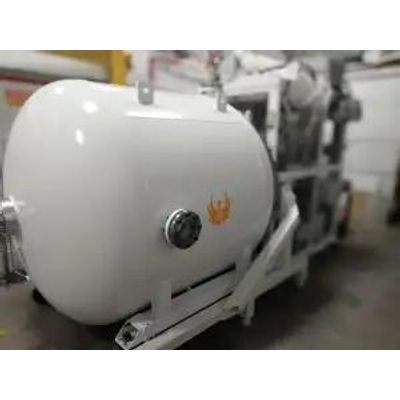
Shine - Neutron Generator Systems
Our groundbreaking neutron generator technology utilizes deuterium-deuterium (DD) and deuterium-tritium (DT) nuclear fusion reactions to generate an extremely high and stable neutron flux. Our neutron generator systems are the strongest fusion-based neutron sources in the world, with a high yield neutron output making them suitable for many applications of both thermal and fast neutrons. This technology forms the backbone of our four-phase mission to achieve and commercialize sustainable, cost-effective fusion based-energy and make the world a safer and healthier place for all.
SHINE Systems and Manufacturing builds what we believe are the strongest compact fusion systems in the world. By using an electrically driven accelerator to produce fusion reactions, our fusion systems can create enough neutron radiation to drive critical applications in industrial manufacturing and nuclear medicine with the potential to serve as a platform for future applications in nuclear waste recycling and energy.
By using a miniature particle accelerator and an ion beam to cause a fusion reaction with neutron production of tens of trillions of neutrons per second, our high-flux neutron generators provide a compact, accessible, clean alternative to reactor facilities with neutron yields suitable for nondestructive testing and medical isotope production.
A fusion system is a device that produces neutron radiation. Fusion systems are one of several sources of neutron radiation. Other sources include nuclear fission reactors, large-scale particle accelerator systems (spallation sources), and intense neutron-emitting elements (such as the synthetic element californium-252, or 252Cf, and other spontaneous fission sources).
Fusion systems come in a wide variety of shapes and sizes, but the common element between all fusion systems is that they use nuclear fusion for neutron production. Unlike other neutron sources, fusion systems do not rely on breaking atoms apart to produce neutron radiation. Instead of splitting heavy elements apart to create lighter ones, a fusion system combines light elements to create heavier ones, liberating a few neutrons from the involved nuclei in the process. The emitted neutrons can be harnessed for many practical purposes.
A fusion system tends to be much more compact than reactors; some are even small enough to fit on a desktop. However, smaller neutron tubes produce a low neutron yield. Low-yield fusion systems are very useful for many applications such as oil well logging, but unlike the intermediate- and high-yield generators SHINE develops, they are not strong enough for certain critical applications.
SHINE has developed the first fusion system that is both high-yield and compact in its design compared to a reactor. With an accelerator-based system capable of producing more neutrons in a sustained reaction than any other man-made fusion reactor, our fusion systems can match nuclear reactor performance in many areas, making them ideal for critical applications such as neutron radiography and medical isotope production.
How do SHINE’s neutron generators work?
Neutron generator technology uses a compact linear particle accelerator to fuse isotopes of hydrogen together. This form of nuclear fusion is called beam-target fusion.
Here’s how it works:
Aim deuterium ions…
Our beam-target electronic neutron generators primarily use a beam of deuterium ions to drive neutron emission. Deuterium is an isotope of hydrogen with one extra neutron in its nucleus (a hydrogen atom typically consists of only a proton and an electron).
By stripping away the single electron of a deuterium atom, you end up with a positively-charged ion consisting solely of a neutron and a proton. The positively-charged ions are consolidated into a high current beam and fired at a target at up to 300kV.
…at hydrogen isotopes…
The target of the ion beam inside a neutron generator can be a solid or a gas, and it can contain either more deuterium or another hydrogen isotope called tritium.
Neutron generators with a deuterium target are known as D-D neutron generators (deuterium-deuterium) because the ensuing fusion reaction caused when the ion beam hits the target is between two deuterium atoms.
Neutron generators with a tritium target are likewise called D-T generators (deuterium-tritium).
…and you get neutron emission!
When the ion beam hits the target, deuterium ions fuse with atoms of deuterium or tritium within the target to create heavier isotopes of hydrogen and produce neutrons. These are emitted from the electronic neutron generator to be used for a wide range of applications.
One key benefit a neutron generator offers over nuclear reactors is that by relying on fusion reactions with light elements such as hydrogen isotopes, they produce very little nuclear waste during neutron production. Unlike reactors, which are very tightly regulated to prevent radioactive isotopes from harming people or the surrounding environment, neutron generators are much cleaner and much easier to safely maintain.
D-D and D-T neutron generators, unlike reactor sources and neutron emitters, can be turned off quickly and easily when the need arises. On the other hand, nuclear reactor shutdown procedures are complex and slow, and neutron emitters like 252Cf cannot be shut off at all.