

- Home
- Companies
- Nikira Labs Inc
- Products
- Nikira Labs - Model OEA - Optical ...
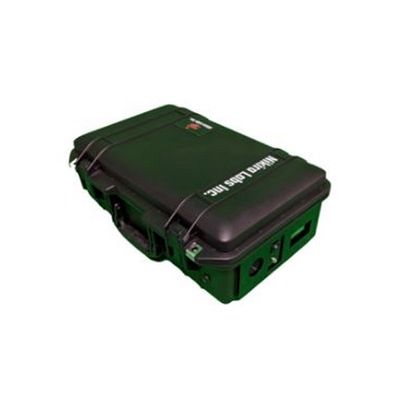
Nikira Labs - Model OEA -Optical Extinction Analyzers
Nikira Labs’ Open-Path Optical Extinction Analyzers (OEAs) are the next generation instruments for visibility and aerosol studies. They measure the optical extinction and visibility in air with unprecedented accuracy. By combining open-path cavity ringdown measurements with a patented self-referencing scheme, the analyzer is able to measure the optical extinction due to ambient aerosols with high precision, minimal sample handling, and little to no drift. The OEA-532 was compared to the Optec NGN-2a Nephelometer in Christman Airfield (Fort Collins, CO). The results showed that the OEA-532 provides much faster data and is able to observe more rapid changes in optical extinction.
- Measure optical extinction and visibility directly from first-principles
- Self-calibration and drift correction enables long-term field deployment
- Open Path sampling provides more accurate results
- No consumables which results in lower operating costs
- Very low maintenance costs and down time
- No external pump means lower required power and lower operational costs
- Can measure multiple wavelengths
Direct Measurement of Optical Extinction & Visibility
The Nikira Labs OEAs provide a direct measurement of optical extinction and visibility using a new, accurate and cost effective method.
Technology
We use an open-path cavity ringdown spectroscopy (CRDS) technology. The result is a compact analyzer that can be used even aboard Unmanned Aerial Systems.
Open-Path, Self-Calibrating Measurements
Since large aerosols are difficult to sample, extinction and visibility measurement are often incorrect in smoke, fog, and haze. The Nikira Labs solution uses a true open-path geometry to accurately measure all aerosols without extractive sampling. Moreover, periodic, automatic self-calibration assures accurate results.
Multiple Wavelengths
- 450nm, 532 nm, 632 nm, 780 nm, 850 nm, 1065 nm and 1650 nm.
- Custom: Nikira Labs offers OEAs that can operate at other wavelengths upon customer request
This turnkey, low-power analyzer can be deployed in a wide variety of environments, allowing for aerosol optical characterization in virtually any location. Use a battery (not included with the OEA) in the field or a wall plug if available.
The OEAs are designed for continuous use and while it is running, it constantly logs data to a data file. It creates a new file every 24 hours and data is backed periodically to a Google drive. The OEA has onboard data storage for more than two years of continuous data. The data can be accessed via USB or cell modem.
- Wavelengths: 450nm, 532 nm, 632 nm, 780 nm, 850 nm, 1065 nm and 1650 nm. Custom wavelengths upon customer request.
- Accuracy/Precision: +/- 1 Mm-1 (nominal)
- Dynamic Range: 0 to >3000 Mm-1
- Data Rate: 1 second
- Measurement Technology: Open-Path Cavity Ringdown Spectroscopy
- Calibration: Self-Calibrating
- Consumables: None
- Temperature Range: -5 to +50 °C
- Humidity Range: 0 - 99% non-condensing
- Size: 49 cm x 33 cm x 18 cm (19.3” x 13” x 7”)
- Weight: 7.7 kg (17.0 lbs)
- Power: 35 W (battery or wall plug operable)
-
Onboard Memory: > 1M readings (2 years of continuous data)
- *Subject to change without prior notice
- Airports - Universal Weather and Aviation
- Highways with history of heavy fog - Fog Detection for Interstate and State Highways
- Highway Tunnels - Chemical Composition of Particulate Matter from Traffic Emissions in a Road Tunnel in Xi’an, China
- Military Applications
- Air Pollution Monitoring - Everything You Need To Know About Aerosols & Air Pollution
- Air Quality - Aerosols and Air Quality Research
- Urban Pollution Monitoring - Urban Air Quality
- Aerosol Research Community - The NSF Center for Aerosol Impacts on Chemistry of the Environment (CAICE)
- Aerosol Flux Networks - Aerosol Fluxes, University of Manchester
- Environmental Research Networks - National Ecological Observatory Network (NEON)
- Climate Change Research - NOAA: Aerosols and Climate
- National Parks - National Park Service: Air Pollution and Visibility
- Forest Areas - US Forest Service Federal Land Managers Visibility Overview
- Volcanic Areas - Volcanic Gases and Aerosols Guidelines
- Desert Areas - Aerosols from pollution, desert storms, and forest fires may intensify thunderstorms
- Ecophysiology Research - Effects of Aerosol Particles on Plants
- Chemical Manufacturing and Research
- Semiconductor Fab and Research
- Clean Rooms