


- Home
- Companies
- NWB Sensors, Inc.
- Products
- NWB - All-Sky Infrared Cloud Imager for ...
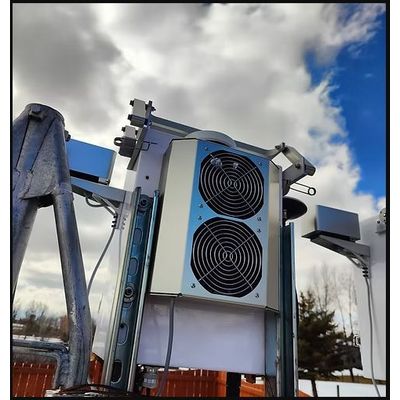
NWB - All-Sky Infrared Cloud Imager for Autonomous Cloud Detection and Characterization
The All-Sky Infrared Cloud Imager (ICI) by NWB is equipped with a calibrated long-wave infrared (LWIR) thermal imaging camera, designed for autonomous detection and characterization of clouds across the full sky. This system operates continuously day and night, providing consistent cloud data unlike visible band systems. Its specialized camera and proprietary data processing techniques enable detection of thin clouds and even some cloud precursors like moist air masses. The ICI has proven functionality in diverse environments such as Haleakala Observatory's high mountain climate, humid sites like Oklahoma’s ARM site, and extreme settings from freezing Montana weather to the hot Californian desert. The system includes a camera enclosure for outdoor installation, connected to a power enclosure in a climate-controlled environment, and is integrated with an automated hatch for lens protection against harsh weather. Additionally, an onboard weather station collects data on wind, temperature, humidity, and pressure, and provides real-time atmospheric precipitable water vapor observations using a Global Navigation Satellite System (GNSS) receiver.The All-Sky Infrared Cloud Imager (ICI) autonomously detects and characterizes clouds over the full sky using a calibrated long-wave infrared (LWIR) thermal imaging camera providing real-time cloud data products. The ICI produces consistent cloud products day and night unlike visible band systems. The calibrated camera and proprietary data processing can detect thin clouds and in some cases cloud precursors, moist air masses.
Instruments have seen operation in the high mountain environment at the Haleakala Observatory in HI, humid environments at an ARM site in Oklahoma and outside of Boston, MA, freezing weather near our home office in Montana, and the hot California desert.
The user-friendly system consists of an environmentally stabilized Camera Enclosure mounted outdoors and connected to a Power Enclosure mounted in a climate-controlled environment. An automated hatch system provides protection for the imager’s lens during rain, snow, and high winds. An integrated weather station connects to the Camera Enclosure and collects atmospheric wind velocity, temperature, humidity, and pressure data. In addition, the system provides real-time atmospheric precipitable water vapor (PWV) observations that are derived using an integrated Global Navigation Satellite System (GNSS) receiver (see PWV Whitepaper for analysis).