


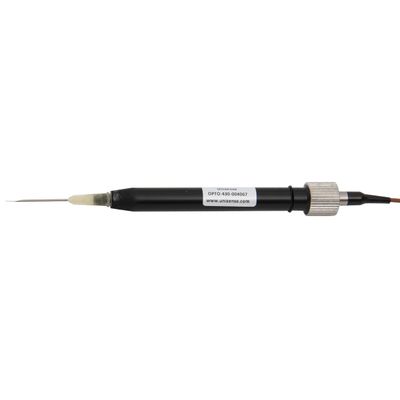
Unisense MicroOptode - O2 Optode Sensor Technology
Unisense offers optode sensor technology with full integration to our existing laboratory systems. The optical sensor technology gives you a cost-effective and robust oxygen sensor that enables a great number of applications.
Simple two-point calibration and temperature compensation ensures ease-of-use, and the Unisense software suite allows you to combine the oxygen MicroOptode with our wide selection of microsensors. You can use the MicroOptodes with our 1 or 4 channel Opto UniAmp, the Field Opto UniAmp, the fx-3 or the fx-6 UniAmp Multi Channel.
The Unisense oxygen optodes are designed for research applications such as:
- Respiration
- Biomedicine
- Bulk and bioreactors
- Environmental sciences
- Profiling
The measuring principle of the oxygen optode is based on Unisense technology and delivers unparalleled performance within our core application segments . Luminescence quenching caused by collision with oxygen molecules makes it possible to determine the oxygen concentration. More oxygen molecules will result in a lower emission signal, providing a measurement of the oxygen concentration in the sample.
The optode fiber is built into a steel needle. This allows you to retract the fiber into the needle for complete protection, e.g. when piercing a rubber septum. When the needle tip reaches the measuring site, the fiber can be pushed out into the sample and measure the oxygen concentration.
Customized versions with fixed exposure for e.g. profiling application and Eddy Covariance are also available.
Combined with our Opto UniAmp, fx-3 and fx-6 UniAmp, the optical sensor technology gives you following advantages:
- Zero-noise temperature compensation
Accurate oxygen quantification by unmatched temperature compensation
- Ambient light filtering technology
Improved performance under fluctuating ambient light conditions, e.g. in situ
- Bleach protection
Novel multi-component modulation improves lifetime with 50%
- 50 µm tip
Optimized design for true microprofiling
- Fast 430 µm sensor
For Eddy Covariance and other applications requiring <0.3s response times
- Robust 3000µm sensor
For bulk and long-time monitoring applications
- E2PROM
Plug'N'Play with unique sensor identification and calibration retrieval