

OceanChlor - Marine Electrochlorination System
OceanChlor Electro Chlorination Package is designed based on seawater electro chlorination system for marine application that uses seawater for cooling has the potential for the formation of bio fouling from the various organisms lurching in the oceans.
The purpose of hypochlorite chlorination system is designed for marine and offshore application. Seawater based electro chlorinator is generally applied for protecting seawater processing pipeline and from bio growth, and being widely applied for the reason of its economic operating cost, as the raw material directly drained from the seawater and only electricity as well.
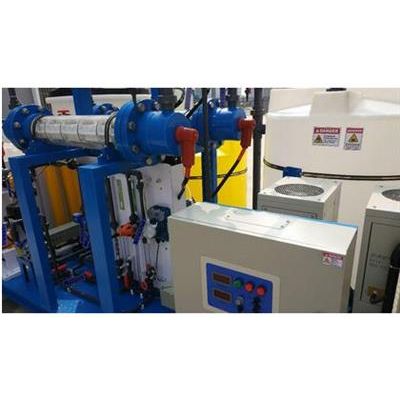
The OceanChlor series electrochlorination system applied with developed Concentric Tubular Electrolyzer (CTE), which does not required acid washing by high velocity. It can reduce the package system footprint, traditional Parallel Plates Electrolyzer (PPE) requires Acid washing by HCl, and as for marine application, it should be very hard to have access of acid, also by applying PPE electrolyzer, the package shall have side system such as neutralization system to prevent hazardous condition might be caused by HCl, and HCl for acid washing and sodium thiosulfate for neutralization system shall be handled caution as well, or it has potential risk of causing irreparable loss for operator and client.
Component of Seawater Electrochlorination
- Seawater Booster Pump
- Auto Backwash Strainer
- OceanChlor Electrolyzer Assembly
- Transformer & Rectifier
- Local Control Panel
- Storage Tank
- Air Blowers
- Injection Pump
* Minimum scope of supply: OceanChlor Electrolyzer Assembly, Transformer & Rectifier, Local Control Panel.
Design Standard
- DNVGL-OS-A101: Safety principles and arrangements
- DNVGL-OS-B101: Metallic Materials
- DNVGL-OS-C102: Structural design of offshore ships
- DNVGL-OS-C301: Stability and Watertight Integrity
- DNVGL-OS-C401: Fabrication and Testing of Offshore Steel Structures
- DNVGL-OS-D101: Marine and Machinery systems and equipment
- DNVGL-OS-D201: Electrical installations
- DNVGL-OS-D202: Automation, safety and telecommunication systems
Typical Seawater Electrochlorination Process Description
Bio fouling control is one of the main challenges in the upstream processes of the power station is to protect pipeline and process equipment against biological fouling. Restriction of cooling water flows, acceleration of corrosion and a reduction in the overall life of process equipment can all be controlled by the effective design of our electro chlorination package. Seawater Electro chlorination system packages play an effective role in optimizing flow assurance. Raw seawater is fed into the package inlet at the designed flow rate via a side stream from the main seawater process line. Once controlled, the seawater is passed through the electrolyzer which are fed an electrical supply from the package rectifier. Depending on pressure available this seawater flow will be pressure controlled or boosted to provide the optimum operating pressure and flow rate (required for the chosen electrolyszer configuration).
The rectifier is designed specifically for the requirements of the installed electrolyzers. It converts the AC platform input voltage into the required low voltage DC current and regulates this output to a selected and controlled level.
Electrolysis process takes place within the electrolyzer as per the following equation:
- At the anode: 2 Cl - 2 e → Cl2
- At the cathode: 2 Na+ 2 H2O + 2 e→ 2 NaOH + H2
- Overall: 2 NaCl + 2 H2O → 2 NaOCl + 2 H2
Through the electrolysis process the package produces the required amount of sodium hypochlorite together with the by-product, hydrogen gas. The solution with hydrogen gas are fed into degassing tank and the hydrogen to vent to open atmosphere.
The hydrogen free solution containing sodium hypochlorite is then dosed into the seawater circuit through dosing pumps or gravity.