


- Home
- Companies
- MTE Instruments
- Products
- MTE Viking - Oceanographic Buoy with ...
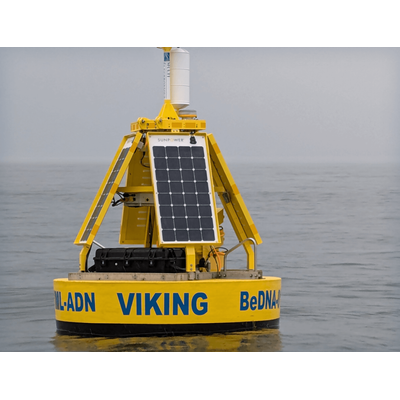
MTE Viking - Oceanographic Buoy with CTD Profiling Winch
The Viking buoy from MTE Instruments is engineered specifically for rigorous oceanographic data collection, designed to withstand the most challenging marine environments. This buoy is outfitted with a unique CTD (Conductivity, Temperature, Depth) profiling winch for detailed and accurate measurements at various depths, crucial for studying thermal structures and ocean currents. Its constructed of corrosion-resistant materials and advanced stabilization systems, ensuring reliability and longevity even in harsh conditions. The integrated wireless communication systems facilitate real-time data transmission, allowing immediate access for rapid analysis. Equipped with long-lasting batteries and solar panels, it provides extended autonomy, essential for long-term monitoring missions. This robust buoy accommodates various additional sensors and is fully compatible with the OceanSIP data visualization platform, making it a powerful tool for scientific research and marine resource management. Its user-friendly interface and easy deployment make it a versatile and essential asset for various oceanographic applications.
The Viking buoy represents a remarkable innovation, designed to meet the rigorous demands of oceanographic data collection. Robust and reliable, this buoy is equipped with a unique CTD profiling winch, allowing for continuous measurement of conductivity, temperature, and water depth. This CTD profiling winch is specifically designed to deploy and retrieve the probe at various depths, providing data of unmatched precision and granularity.
The design of the Viking buoy incorporates corrosion-resistant materials and advanced stabilization systems, ensuring optimal operation even in the most challenging marine conditions. The CTD profiling winch is automated and programmable, allowing for regular and consistent vertical profiles, which are essential for studying thermal structures and ocean currents. The collected data is transmitted in real-time via wireless communication systems, enabling immediate access and rapid analysis.
Additionally, the Viking buoy is equipped with long-lasting batteries and solar panels, ensuring extended autonomy for long-term monitoring missions. This unique combination of robustness, advanced technology, and reliability makes the Viking buoy an indispensable tool for scientists and marine resource managers, facilitating informed decision-making and cutting-edge oceanographic research.
Innovative CTD profiling winch: The Viking buoy is equipped with a unique CTD (Conductivity, Temperature, Depth) profiling winch, specifically designed to deploy and retrieve the CTD probe at various depths. This winch is automated and programmable, allowing for regular and consistent vertical profiling, which is essential for studying thermal structures, ocean currents, and other oceanographic phenomena.
Complementary sensors: In addition to CTD profiling, the Viking buoy can be equipped with various additional sensors, such as turbidity sensors, chemical sensors (measuring pH, dissolved oxygen, and CO2), and ADCPs (Acoustic Doppler Current Profilers) for measuring ocean currents in three dimensions. These sensors provide comprehensive coverage of the environmental parameters needed for scientific research.
High-quality materials and durable design: The Viking buoy is made with corrosion-resistant materials and built to withstand the harshest weather conditions, ensuring great durability even in the most demanding marine environments. The buoy’s structure is optimized to endure challenging maritime conditions, guaranteeing a long lifespan and minimal maintenance. Its buoyancy is provided by an unsinkable ionomer foam body, eliminating the need for air leakage tests and the upkeep of a periodically repainting surface.
Real-time data transmission: The Viking buoy is equipped with wireless communication systems that enable real-time transmission of collected data. This data can be sent directly to a data management platform, such as OceanSIP, providing instant access to the collected information and allowing for quick analysis.
Energy supply and autonomy: The Viking buoy is powered by long-lasting batteries, supplemented by solar panels that recharge the batteries, thus extending the device’s autonomy. This allows the buoy to operate independently for extended periods, which is essential for long-term monitoring missions.
Compatibility with OceanSIP: The Viking buoy is fully compatible with MTE Instruments’ OceanSIP cloud dashboard. OceanSIP provides intuitive and detailed data visualization, making it easier to analyze ocean conditions and make informed decisions.
Collection of accurate and reliable data: Thanks to its CTD profiler winch and high-precision sensors, the Viking buoy provides accurate and reliable data on essential oceanographic parameters. This data is crucial for scientific research, marine resource management, and environmental monitoring.
Adaptability to various applications: The Viking buoy is extremely versatile and can be used in a wide range of applications, including monitoring fish spawning areas, studying coastal currents, monitoring mariculture zones, observing climate change, and hydrographic applications. This adaptability makes it a valuable tool for many research and engineering projects.
Durability and strength: The robust design of the Viking buoy ensures its durability and resistance in the toughest marine environments. This longevity reduces maintenance costs and ensures continuity in data collection, which is essential for long-term monitoring missions.
Ease of deployment and use: The Viking buoy is designed to be easily deployed by a small team with a simple anchor setup. Additionally, it features a user-friendly and intuitive interface for controlling and programming the sensors. This allows research teams to save time during deployment and focus on data collection and analysis.
Real-time surveillance: The Viking buoy’s ability to transmit real-time data enables researchers and managers to respond quickly to changes in ocean conditions. This feature is particularly useful for managing marine resources and for real-time monitoring applications.
Easy integration with data management platforms: The integration of the Viking buoy with data management platforms like OceanSIP facilitates data visualization and analysis. Users can customize their dashboards to display the most relevant information for their specific missions, enhancing the efficiency and accuracy of their analyses.
Technical support and customer service: MTE Instruments provides comprehensive technical support for the Viking buoy, including training, installation, and maintenance services. Customers can rely on prompt and effective assistance to maximize the performance of their equipment and quickly resolve technical issues.
The Viking buoy, equipped with its innovative CTD profiler winch, monitors fish spawning areas to understand the environmental conditions influencing the reproduction of marine species. In strategic zones, the buoy regularly profiles the water column. The CTD profiler winch collects accurate data on temperature, salinity, and depth at various water strata. These measurements help scientists study environmental variations affecting spawning habitats, such as temperature and salinity that impact the survival of fish eggs and larvae. Real-time monitoring allows for quick detection of anomalies for effective management of marine resources. The data is transmitted instantly via wireless systems, enabling remote monitoring and efficient collaboration. The extended autonomy of the Viking buoy ensures continuous monitoring of marine environments for the protection of fish spawning areas.
The Viking buoy equipped with a CTD probe winch represents a significant advancement in oceanographic studies, particularly in the monitoring and analysis of ocean temperatures. By deploying this advanced technology, researchers can gather accurate data on thermal variations at different depths and geographical locations. This enables detailed mapping of ocean thermal gradients, essential for studying the effects of climate change on marine ecosystems and for forecasting long-term ocean temperature trends. The Viking buoy thus provides a reliable and efficient platform for the continuous collection of crucial oceanographic data, facilitating a better understanding and management of marine resources.
In the field of hydrography and seabed mapping, using a CTD probe winch like the one integrated into the Viking buoy offers significant advantages. In addition to measuring water temperature, the CTD probe helps compensate for readings from the echo sounders used to map the seabed. Temperature variations influence the speed of sound in water, which can affect the accuracy of traditional echo sounders. By integrating the temperature data obtained from the CTD probe, hydrographers can correct these variations and improve the accuracy of bathymetric maps. This not only provides more detailed and accurate maps of the seabed but also enhances understanding of the thermal structure of the oceans, essential for many scientific and environmental applications. Thus, the application of CTD technology in hydrography offers an integrated and improved approach to ocean mapping and the sustainable management of their resources.