


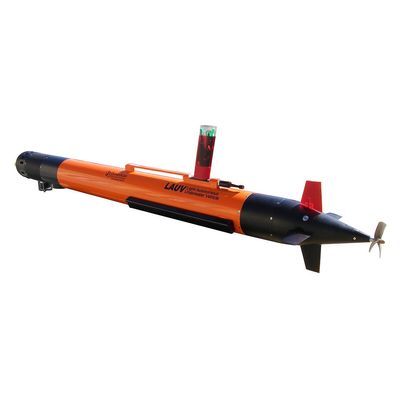
OceanScan LAUV - Versatile Light Autonomous Underwater Vehicle for Marine Surveys
The Light Autonomous Underwater Vehicle (LAUV) by OceanScan is a compact, rugged autonomous underwater vehicle optimized for single-person operations. Designed with simplicity and efficiency in mind, its open architecture facilitates easy integration of instruments, sensors, and algorithms. A basic LAUV system incorporates a computational system, radio communications, and navigation sensors, with options for enhanced navigation, communication, and payload modules. Neptus, the command and control software, supports various operation stages, including configuration, planning, simulation, and data analysis. The LAUV is particularly suited for oceanographic, hydrographic, and surveillance surveys due to its cost-effectiveness and operational efficiency. Its low-logistics setup requires only a laptop and communication hub for deployment from shore or watercraft, eliminating the need for cranes or specialized tools. The modular design allows for personalized enhancements, while the open-source software enables customization of algorithms and behaviors. All components undergo rigorous testing, ensuring operational reliability even in harsh environments.
The LAUV – Light Autonomous Underwater Vehicle – is a rugged, effective, lightweight autonomous underwater vehicle. Designed to be simple to deploy, operate, and recover by a single person. The state-of-the-art open architecture, allow users to easily integrate new instruments, actuators, algorithms and behaviors.
A LAUV basic functional system includes a computational system, radio communications and basic navigation sensors, the LAUV capabilities build up adding optional navigation, communications and payload modules.
The LAUV operation is supported by Neptus, the command and control software tailored for the operation of one or more vehicles. This advanced, but user-friendly, software framework covers all the different stages of the mission life cycle: configuration, planning, simulation, execution and post-mission data analysis.
The LAUV is a cost-effective and innovative system targeted at oceanographic, hydrographic and security and surveillance surveys.
A very simple operational setup including a laptop and a portable communication hub enables full operation of one or more vehicles. The LAUV can be deployed from shore, a pier or a small boat without the need to use a crane or special tools.
The LAUV can be easily deployed and recovered by a single person, due to its small size and lightweight.
To ensure practical usefulness and full operationality in the harshest environments, all the design options concerning mechanical, hardware and software developments are thoroughly tested before release.
The LAUV payload and navigation options are integrated as independent modules that can be installed later or replaced by different modules and/or user developments.
The software suite of the LAUV is based on the open source LSTS toolchain from Porto University. Users can easily reuse code to add new algorithms, behaviors and sensors.
An affordable tool designed to be cost effective, including reduced operation and maintenance costs.
- Depth rating: 100 meters
- Endurance:
- Typical: > 8 hours @ 3 knots
- Specific Configurations: > 48 hours @ 2 knots
- Speed: up to 5 knots
- Hull diameter: 15 cm
- Length: 115 up to 230 cm
- Weight in air: 15 up to 35 Kg
- Standard Navigation: GPS, AHRS, Depth sensor
- Standard Communication: Wi-Fi and GSM/HSDPA
Flexible fins
- To increase the system robustness without affecting the system performance, the fins and antennas mast are flexible
External ballast rail
- The weight of the LAUV can be easily adjusted for fresh and saltwater operations, adding or removing ballast weights from the external ballast rail
Powered by Lithium-ion batteries
- Typically the LAUV is equipped with enough power for a regular day of operation (8 hours). Nevertheless, with a fast charging time, the LAUV is ready for a new operation in less than 2 hours
Forward Looking Sonar
- Particularly useful to avoid large obstacles during operations
Open source software
- The LAUV on-board and off-board software is based on the open source toolchain developed by LSTS from Porto University.
External USB Pen for data logging
- Fast access to collected data is guaranteed via an external USB pen mounted on the LAUV nose. Exchange a full USB pen by an empty one and the LAUV is ready for a new mission. Meanwhile you can review the collected data in your laptop.
Improved communication range
- When on surface you can access the LAUV via the Manta gateway extended range Wi-Fi radio. When the LAUV is out of the Wi-Fi range, the GSM module can be the alternative solution or the Iridium.
Safety features
- The LAUV includes several safety features making sure you have the LAUV always in control. The safety features includes: report of the LAUV status and estimated position via Wi-Fi, GSM, Iridium or acoustic modem; abort a mission via acoustic modem; stand alone acoustic pinger; and many others.
Remote control via smartphone
- Install the LAUV remote app in your smartphone and you can tele-operate the LAUV and check the system status.
Support for multi-vehicle operations
- Support for multi-vehicle operations
Easily deployed from shore or a small boat
- The LAUV lightweight and small size makes possible to be easily deployed. No cranes or special tools are required. After deployed on the water, the LAUV can be tele-operated to the operation area.