
- Home
- Companies
- Onda Corporation
- Products
- OndaSonics - Model MCT-1200 - Digital ...
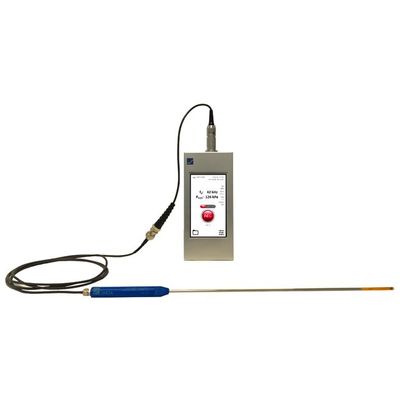
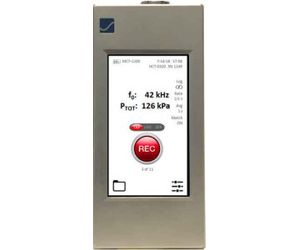
OndaSonics - Model MCT-1200 -Digital Cavitation Pressure Meter
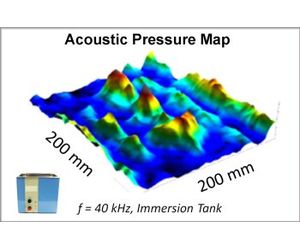
The HCT hydrophone with MCT-1200 Digital Pressure Meter is a trustworthy instrument to characterize and monitor the relative acoustic cavitation in ultrasonic cleaning systems. Its unique single point sensing design allows localized measurements to generate true 3-cimensional acoustic maps of the cleaning tank.
Some other key features include:
- Parameters: F0 and PTOT
- Data logging
- Self-Calibration to MCT-2000
- Touchscreen
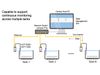
- Real-time data transfer for continuous monitoring
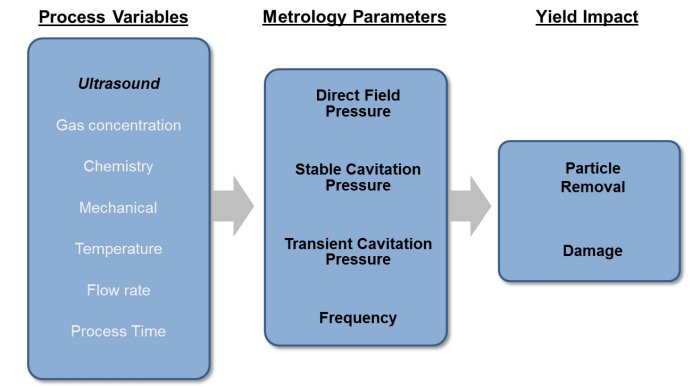
For many ultrasonic cleaning processes, achieving a uniform acoustic field is challenging. This is because there is a broad range of process variables that affect the acoustic field distribution including transducer-to-transducer variation, gas concentration, temperature gradients, flow rate, among others. Ultimately, this contributes to how well particles are removed directly affecting process yield.
Despite the wide adoption of ultrasonic cleaning, the acoustic characteristics are not well understood. The portable HCT hydrophone with MCT pressure meter bridges this gap, offering a reliable solution to characterize and monitor the acoustic properties of ultrasonic cleaners. Its unique single point sensing design allows measurements with high spatial resolution to offer true 3-dimensional mapping of the cleaning tank. The rugged construction allows routine mapping of the acoustic pressure and ultimately determination of the cleaning efficiency of the tank.
- Acquire acoustic maps to optimize cleaning efficiency of ultrasonic baths
- Routinely spot check acoustic field of cleaning tank for process control monitoring
- Continuously monitor the acoustic output by integrating with a central PC
- Compare tank-to-tank performance to maintain matching in production environments
- Tune process recipes by characterizing the ultrasonic cleaner fully loaded with substrates
- Identify cleaning tank issues such as debonded or malfunctioning transducers
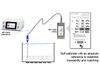
- Self-calibrate with an absolute reference meter to match test results
HCT-0320 Hydrophone
- Useful Frequency Range: 20 to 1200 kHz
- Maximum Operating Temperature: 70 ºC
- Chemical Compatibility: pH Range 4 to 12 (Teflon)
- Probe Dimensions:
- Shaft Length: 270 mm
- Shaft Diameter: 3 mm
- Handle Length: 80 mm
- Handle Diameter: 12 mm
- Cable: LEMO connector with embedded hydrophone calibration file, 1.5 meter length
- Hydrophone Slide (Optional): 40, 80, 120, 160, 200 cm
MCT-1200 Pressure Meter
Measured Parameters:
- Fundamental Frequency, FO (kHz)
- Total Pressure, PTOT (kPa or unitless) *
* kPa units require self-calibration to absolute reference
Data Management:
- Touch panel display
- Time averaging interval: 1-60 sec
- Data logging to local memory
- Self-calibration to match with reference meter
- Remote access via Ethernet
- Real-time data transfer for continuous monitoring
- Power: rechargeable battery, charger (5 VDC, 3A)
- Labels: CE Mark, FCC
- Dimensions: 76 mm (W) x 169 mm (H) x 30 mm (D)
Specifications are subject to change without notice.
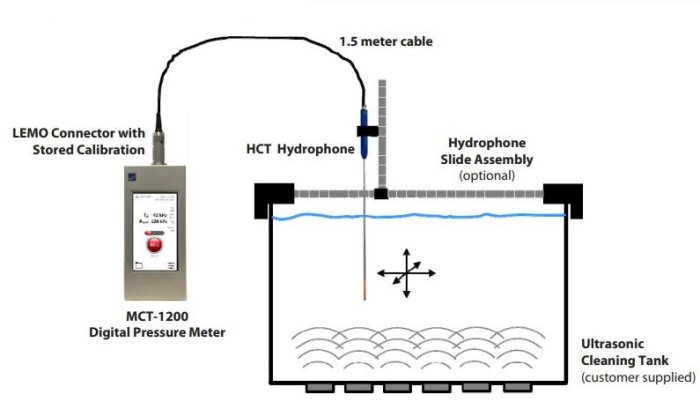
- Application(s): Continuous & routine monitoring
- Measurement Parameters:
- Frequency, F0 (kHz)
- Total Pressure, Ptot (unitless or kPa*)
- * Requires self-calibration to absolute reference
- Hydrophone Interface:
- Compatible with HCT Hydrophone
- Connector with embedded calibration file
- Electronic Bandwidth: Up to 10 MHz
- Data Management: Touch panel display
- Time averaging interval: 1-60 sec
- Data logging to local memory
- Self-calibration to a reference
- Real-time continuous data transfer
- Save: Parameters
- Power: Portable, Battery Operated (5VDC, 3A)
- Dimensions: 76 mm (W) x 169 mm (H) x 30 mm (D)
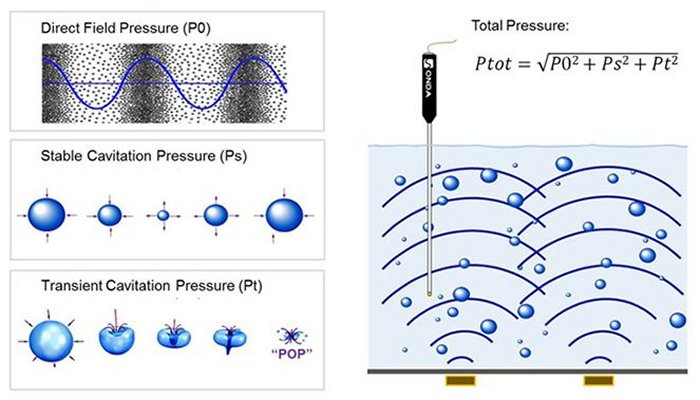
Ultrasonic cleaning relies on the mechanical agitation from sound pressure that disrupts the surface boundary layer to allow particles to detach and flow into the bulk fluid.
There are 3 primary forms of ultrasonic pressure that contribute to this:
- Direct Field Pressure (P0) – Vibrations from oscillating transducers mounted to the cleaning tank are transferred to the cleaning liquid to create acoustic pressure waves. These sound waves oscillate at the drive frequency of the tank, rapidly changing in pressure (P+ to P-) and creating cavities or “cavitation” within a liquid. The cavity size is a function of the Fundamental Frequency (F0).
- Stable Cavitation Pressure (Ps) – Micro-bubbles (or cavities) in the liquid, generated from the direct field pressure, oscillate in size and shape causing the surrounding fluid to move. This results in strong shear forces in the vicinity of a solid surface, removing particles. This form of cavitation is also known as non-inertial cavitation.
- Transient Cavitation Pressure (Pt) – When the acoustic field is strong enough (i.e., beyond the “cavitation threshold”), the cavities may oscillate to the point where they collapse resulting in shock waves that dislodge particles from a solid surface. This form of cavitation is also known as inertial cavitation.
At a given time, all mechanisms may actively contribute to particle removal overcoming attractive van der Waals, capillary, and electrostatic forces.
Please view the video that describes the various mechanisms which contribute to cleaning.
The influence from each mechanism will depend on conditions such as the drive frequency, electrical input power, gas concentration, chemistry, temperature, and other process variables. For instance, it is generally recognized that transient cavitation is more prevalent at ultrasonic frequencies (20-500 kHz) while stable cavitation dominate at “megasonic” frequencies (> 500 kHz). This is why higher frequencies are more common for precision cleaning processes that are sensitive to damage.
The advancement of ultrasonic and megasonic cleaning processes for applications (semiconductor, masks, storage devices, solar cells, etc.) drive the need to characterize the acoustic performance under complex process conditions. The primary cleaning mechanism is achieved by applying ultrasonic energy to the cleaning solution. These sound waves generate cavitation, where bubbles are formed and either oscillate or implode, dislodging and removing contaminants from the substrate surface.
Ongoing research is being conducted to understand how variables such as the acoustic pressure, drive frequencies, and concentration of dissolved gases affect the cleaning efficiency. To control advanced wet clean processes, such as semiconductor and electronic cleaning, upper and lower controls are established to not only ensure maximum particle removal efficiency (PRE) but also to limit any damage on fragile features or surfaces. Establishing and controlling a process window has proven to be critical to maintain high device yields.