


- Home
- Companies
- JINSP Company Limited
- Products
- JINSP - Online Raman Analyzer for ...
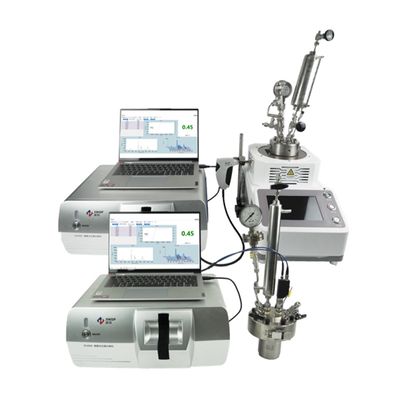
JINSP - Online Raman Analyzer for In-Situ Reaction Monitoring
The Online Raman Analyzer is specifically designed for in-situ, real-time, and continuous monitoring of chemical reactions and biological processes. It provides valuable insights into reaction mechanisms and supports process development and optimization, ensuring precise process control. Unlike traditional methods, this analyzer does not require sampling or sample processing, minimizing interference and enabling it to withstand extreme conditions such as high temperatures and pressures, and strong corrosive environments. The system delivers real-time analytical results within seconds, facilitating quick detection of reaction endpoints and anomalies. Its robust design is ideal for applications in the chemical, pharmaceutical, and materials sectors, allowing for real-time analysis in challenging environments. Technical highlights include its ability to function under conditions of strong acids or alkalines, and its capability for single-channel continuous data collection, supplemented by advanced data analysis software that provides detailed insights into unknown components and quantitative modeling.In-situ, real-time, continuous on-line analysis of chemical reactions and biological processes for the study of reaction mechanisms, process development and optimization, and for the realization of precise process control.
- Can withstand extreme reaction conditions such as strong acid, strong alkali, strong corrosiveness, high temperature, and high pressure.
- Real-time response in seconds, no need to wait, providing analysis results promptly.
- No sampling or sample processing required, in-situ monitoring without interference to the reaction system.
- Continuous monitoring to quickly determine the reaction endpoint and alert for any anomalies.
Chemical/pharmaceutical/materials process development and production requires quantitative analysis of components. Usually, offline laboratory analysis techniques are used, where samples are taken to the laboratory and instruments such as chromatography, mass spectrometry, and nuclear magnetic resonance spectroscopy are used to give information on the content of each component. The long detection time and low sampling frequency cannot meet many real-time monitoring needs.
JINSP provides online monitoring solutions for chemical, pharmaceutical, and material process research and production. It enables in-situ, real-time, continuous, and rapid online monitoring of the content of each components in reactions.
- Analysis of Chemical Reactions/Biological Processes under extreme conditions
- Under conditions of strong acids, strong alkalis, high temperature, high pressure, strong corrosion, and toxicity, conventional instrument analysis methods may face challenges in sampling or cannot withstand active samples. However, online monitoring optical probes, specially designed to adapt to extreme reaction environments, stand out as the sole solution.
Typical Users: Researchers involved in extreme chemical reactions at new material companies, chemical enterprises, and research institutes.
- Under conditions of strong acids, strong alkalis, high temperature, high pressure, strong corrosion, and toxicity, conventional instrument analysis methods may face challenges in sampling or cannot withstand active samples. However, online monitoring optical probes, specially designed to adapt to extreme reaction environments, stand out as the sole solution.
- Research and Analysis on Intermediate Reaction Components/Unstabl
- Short-lived and unstable reaction intermediates undergo rapid post-sampling changes, making offline detection inadequate for such components. In contrast, real-time, in-situ monitoring through online analysis has no impact on the reaction system and can effectively capture changes in intermediates and unstable components.
Typical Users: Experts and scholars from universities and research institutes interested in the study of reaction intermediates.
- Short-lived and unstable reaction intermediates undergo rapid post-sampling changes, making offline detection inadequate for such components. In contrast, real-time, in-situ monitoring through online analysis has no impact on the reaction system and can effectively capture changes in intermediates and unstable components.
- Time-Critical Research and Development in Chemical/Bio-processes
- In research and development with tight timelines, emphasizing time costs in chemical and bioprocess development, online monitoring provides real-time and continuous data results. It promptly reveals reaction mechanisms, and big data assists R&D personnel in understanding the reaction process, significantly accelerating the development cycle.Traditional offline detection provides limited information with delayed results, leading to lower R&D efficiency.
Typical Users: Process development professionals in pharmaceutical and biopharmaceutical companies; R&D personnel in new materials and chemical industries.
- In research and development with tight timelines, emphasizing time costs in chemical and bioprocess development, online monitoring provides real-time and continuous data results. It promptly reveals reaction mechanisms, and big data assists R&D personnel in understanding the reaction process, significantly accelerating the development cycle.Traditional offline detection provides limited information with delayed results, leading to lower R&D efficiency.
- Timely Intervention in Chemical Reactions/Biological Processes with Reaction Anomalies or Endpoints
- In chemical reactions and biological processes such as biofermentation and enzyme-catalyzed reactions, the activity of cells and enzymes is susceptible to the influence of relevant components in the system. Therefore, real-time monitoring of abnormal concentrations of these components and timely intervention are crucial for maintaining efficient reactions. Online monitoring provides real-time information about the components, while offline detection, due to delayed results and limited sampling frequency, may miss the intervention time window, leading to reaction anomalies. Typical Users: Research and production personnel in biofermentation companies, pharmaceutical/chemical companies involved in enzyme-catalyzed reactions, and enterprises engaged in the research and synthesis of peptides and protein drugs.
- Product quality/Consistency Control in Large-Scale Production
- In the large-scale production of chemical and biological processes, ensuring the consistency of product quality requires batch-by-batch or real-time analysis and testing of reaction products. Online monitoring technology, with its advantages of speed and continuity, can automate quality control for 100% of batch products. In contrast, offline detection technology, due to its complex processes and delayed results, often relies on sampling, posing quality risks for products not sampled.
Typical Users: Process production personnel in pharmaceutical and biopharmaceutical companies; production personnel in new materials and chemical companies.
- In the large-scale production of chemical and biological processes, ensuring the consistency of product quality requires batch-by-batch or real-time analysis and testing of reaction products. Online monitoring technology, with its advantages of speed and continuity, can automate quality control for 100% of batch products. In contrast, offline detection technology, due to its complex processes and delayed results, often relies on sampling, posing quality risks for products not sampled.