


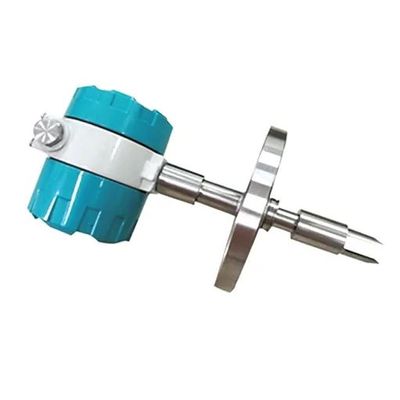
HYKO - Model 701 -Online Vibration Density Meter
Tuning fork vibration density measurement is a method of measuring the density of liquids and gases using a vibrating tuning fork. It works on the principle that the resonant frequency of a tuning fork is affected by the density of the surrounding medium. The design and working principle of a tuning fork vibration density sensor typically consists of the following components:
Design:
- A vibrating tuning fork: The tuning fork is typically made of a metal such as stainless steel and is designed to vibrate at a specific resonant frequency.
- A piezoelectric transducer: This component is used to convert the mechanical vibrations of the tuning fork into electrical signals.
- An electronic circuit: This circuit is used to amplify and process the electrical signals generated by the piezoelectric transducer.
- A temperature sensor: This sensor is used to measure the temperature of the medium being measured and to compensate for the effect of temperature on the resonant frequency of the tuning fork.
Working Principle:
- The tuning fork is excited to vibrate at its resonant frequency by the piezoelectric transducer.
- The tuning fork is immersed in the medium whose density is to be measured. The density of the medium affects the resonant frequency of the tuning fork.
- The electronic circuit measures the frequency of vibration of the tuning fork and compares it to the known resonant frequency of the tuning fork in air.
- The temperature sensor is used to measure the temperature of the medium being measured and to compensate for the effect of temperature on the resonant frequency of the tuning fork.
- The difference between the measured frequency and the known resonant frequency in air is used to calculate the density of the medium.
HYKO tuning fork vibration density measurement is a method of measuring the density of liquids and gases by measuring the resonant frequency of a vibrating tuning fork, which is affected by the density of the surrounding medium. The design and working principle of a tuning fork vibration density sensor typically consists of a vibrating tuning fork, a piezoelectric transducer, an electronic circuit and a temperature sensor. This method is highly accurate and suitable for use in a wide range of industrial applications.
- Measurement range: 0.5-2.5 g /cc (500-2500kg/m3)
- Measure Range 0-2500kg/m3
- Function: Test Density or Concentration
- Temperature range: -50 c ~+150 c
- Accuracy ±2kg/m3
- Max Working Pressure: 207bar (3000psi)
- Medium Viscosity: 0-20000cp
- Power Supply: 24 V DC
- Signal Output: 4-20mA /RS485Modbus RTU
- IP Grade: IP65
- Wetted Material: SS316/SS2205/Hastelloy C/PTFE
- Process Connecting: Flange /clamp
- Installation Pipe Request: Min DN100, full flow pipe,
- flow speed less than 5m/s
- Accurate density and concentration measurement.
- Continuous, real-time measurement in pipelines, bypass loops, and tanks.
- Accurate measurement of density (±1 kg/m3) and concentration (up to ±0.1%)
- Wide range of corrosion-resistant materials for aggressive liquid measurement.
- Hazardous-area approved, head-mounted transmitter that supports local configuration and display
- Internal diagnostics for fast verification of meter health and installation
- Application-specific factory configurations ensure fit-for-purpose operation
- Optimized design – insensitive to vibration, temperature, and pressure variations
- Unique direct insertion design in lengths of up to 13 ft (4 m)
- Supports multiple protocols for connection to Distributed Control Systems (DCSs), programmable logic controllers (PLCs), and
- flow computers
- Installation flexibility and compatibility, Easy installation, free maintenance.
HYKO Tuning fork vibration density measurement can be used in a wide range of industrial applications, including:
- Process control: Tuning fork density sensors are used to monitor the density of liquids and gases in industrial processes, such as in the chemical, petrochemical, and pharmaceutical industries.
- Quality control: They can be used to measure the density of liquids and gases in quality control applications, such as in the food and beverage industry, where the density of liquids is used to determine the concentration of certain ingredients.
- Environmental monitoring: They can be used to measure the density of liquids and gases in environmental monitoring applications, such as in the waste water treatment industry, where the density of liquids is used to determine the concentration of pollutants.
- Oil and gas industry: They can be used to measure the density of crude oil, refined products and natural gas in the oil and gas industry, as density is an important parameter in the production, processing and transportation of these materials.
- Laboratory: They can be used in laboratory settings to measure the density of liquids and gases for research and development purposes.
- Pharmaceuticals: They can be used in the pharmaceutical industry for measuring the density of liquids and gases in the manufacturing of drugs, to ensure quality control and compliance.
Our tuning fork vibration density measurement can be used in a wide range of industrial applications, including process control, quality control, environmental monitoring, oil and gas industry, laboratory and pharmaceuticals. It is a highly accurate method of measuring the density of liquids and gases, and can be used in a variety of industries to ensure quality control and compliance.