


- Home
- Companies
- Optimax Systems, Inc
- Products
- Optimax - Optical Prisms
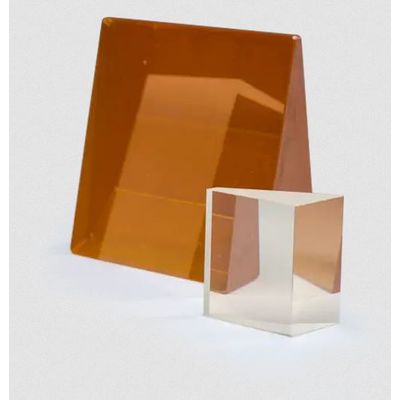
Optimax - Optical Prisms
Original equipment manufacturers (OEMs) benefit from unparalleled expertise and precision when working with Optimax. Our team of engineers is experienced applying our know-how to deliver cutting-edge technical solutions. This allows us to take on challenges that exceed the capabilities of other manufacturers.
Optical prisms, for example, which are ground and polished to create geometrically complex optical components with extremely tight tolerances, represent a costly bottleneck for many optics fabricators. Their variability makes it difficult to process prisms at large scales or via automated processes. At Optimax, we can confidently commit to delivery schedules of a single week for optical dispersion prisms, blocks, doves, right angles, mirror substrates, and more.
We specialize in the fabrication of optical prisms of up to 300 mm in diameter, and can reliably generate prototype prisms upon request.
Optical prisms differ from traditional lenses in that they have neither a spherical surface nor an axis of symmetry. Instead, they comprise two or more nominally plano surfaces divided by a wedge angle. This alters the language used to define and specify optical prisms, and it typically increases production time due to increased part complexity and a greater number of sides requiring precision finishing.
The significance of these geometries is that they will reflect or refract light, resulting in several distinct functions: dispersion, deflection, reflection, and rotation. These go on to serve critical applications in dual channel instruments, anamorphic systems, imaging systems, and any other application where beam steering and/or image manipulation is needed.
Optical prisms vary dramatically by size, shape, and number of surfaces. Defining the part geometry requires a careful selection of directly measurable physical parameters, including linear dimensions of the plano surfaces to theoretical sharps (the intersection that would exist between the two if the corner was not beveled). Manufacturers must also specify part thickness, which is the depth of separation between the two plano surfaces at a single point on the optic. At Optimax, we choose to specify the thickest edge as it offers ease-of-measurement access, but we can specify our optical prisms by the centerline thickness, or the thinnest edge if necessary.
At Optimax, we specialize in manufacturing optical prisms up to 300 mm in diameter, and with our state-of-the-art grinding and smoothing technologies, can deliver prisms in a variety of complex geometries to tightly-defined surface flatness.
-
Blocks
-
Brewster
-
Cubes
-
Doves
-
Polygons
-
Rhomboids
-
Right angles
-
Alignment aides
-
Beam splitting/folding
-
Grating substrates
-
Light pipes
-
Mirror substrates