


- Home
- Companies
- edevis GmbH
- Products
- OTvis - Optically Excited Lockin ...
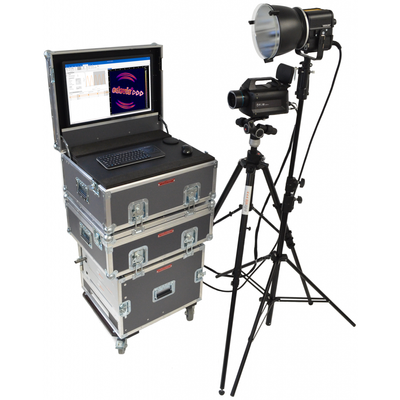
OTvis - Optically Excited Lockin Thermography Systems for Non-Destructive Testing
Optically excited lockin thermography is a sophisticated non-contact, non-destructive testing technology optimized for analyzing fiber-reinforced plastics (CFRP) in both aerospace and automotive sectors. This technique is particularly advantageous in scenarios demanding rapid assessment of large, geometrically complex areas. It operates effectively under diverse environmental conditions, making it suitable for both production and maintenance workflows. By employing sinusoidal modulation of halogen lamp intensity, the system facilitates precise heat flow analysis. This modulation results in phase and amplitude images that are produced from captured infrared sequences via Fourier transformation, significantly enhancing defect detection by reducing interference from varied emission coefficients or inhomogeneous excitation. The method is seamlessly expandable with edevis’ suite of excitation sources and software. Typical applications include evaluating impact damages, delaminations, and variations in material thickness, providing critical insights into the structural integrity of components.
Optically excited lockin thermography is a non-contact, non-destructive testing method that is very well suited for characterising fibre-reinforced plastics (CFRP) in the aerospace and automotive industries. The method is particularly used when short measurement times are required. Large areas with complex geometry can be examined with one measurement. The lockin technique is very robust and also works under difficult environmental conditions. The method is used in production as well as in maintenance. OTvis is expandable with all other edevis excitation sources and software modules.
OTvis – advantages for large components, surfaces, carbon fibre, CFRP
- Optically excited lockin thermography is a non-contact testing method
- Ideal for the characteriaztion of carbon fibre composites (CFRP)
- Depth-resolved defect detection and wall thickness determination
- Excellent for testing large areas in the square metre range