

- Home
- Companies
- TANIQ B.V.
- Products
- TANIQ - Optimised Cord Reinforcement
TANIQ - Optimised Cord Reinforcement
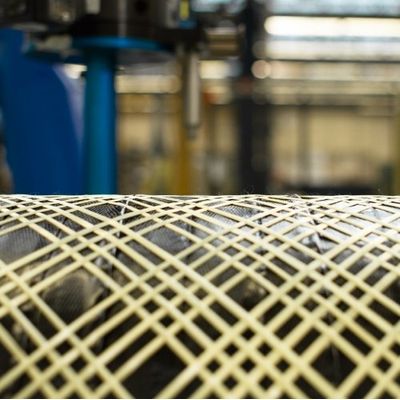
TANIQ is specialized in the design of cord reinforcement structures for rubber products. For optimal reinforcement of (rubber) products TANIQ uses design principles for lightweight engineering from the Aerospace industry (TANIQ is a spin-off from Aerospace Faculty of Delft Univeristy of Technology). TANIQ strives to optimize the use of the cords by calculating their optimal path trajectories (e.g. geodesic path) and accurately placing them on those trajectories using industrial robots.
Cord reinforced rubber products combine a rubber and a reinforcing material, so high strength to flexibility ratios can be achieved. The reinforcing material provides the strength and stiffness. Simultaniously, the rubber matrix, with low strength and stiffness, provides air-fluid sealing. By calculating the optimal product shape and by placing the cords on their ideal paths, the cords are purely loaded on tensile stress and use 100% of their strength. Under these conditions the cord structure takes up all the forces. Hence the rubber does not have to take up sheer stresses and is solely used for sealing. This way, both materials are used most efficiently. Furthermore, it also means that the reinforcement structure is in equilibrium state and therefore the product will not expand, shorten or lengthen under pressure. Knowing the force equilibrium of the reinforcement structure, it is also possible to deliberately adjust the product shape and path angles to obtain predictable and controlled shape expansion.
Two important design features are geodesic cord paths and isotensoid shapes. A geodesic path is the shorthest path between two points on a (curved) surface. In a reinforcement structure, placement on the geodesic path ensures efficient use and loading of the reinforcement material. A cord reinforced isotensoid shape is a shape where the resulting stresses are aligned with the cord direction resulting in constant stress throughout the product. As a result the cords in such product are purely loaded on tensile strength and the product will not deform under influence of internal pressure. Geodesic paths in combination with an isotensoid shape will result in optimised material usage and loading.
The optimal path for reinforcement loading depends on the product's contours. In case of cylindrical products, the neutral winding angle (e.g. straight rubber hose) is approximately 54.7 degrees. Accurate placement of reinforcement cords on this path results in purely tensile stresses exerted on the reinforcement structure. Thereby, 100% of the load is absorbed by the cords for any pressure (up until the cords are loaded 100% of their tensile strength). Hence the rubber does not have to take up sheer stresses and is solely used for sealing. This way, both materials are used most efficiently. Furthermore, it also means that the reinforcement structure is in equilibrium state and therefore the product will not deform, expand, compress or elongate under pressure.
This basic principle for hoses also applies for convoluted products. However, calculation of this optimized angle is a lot more complex and depends on the local contour of each single point of the product. Hence, the angle at which optimized loading is realized varies over the product. TANIQ has developed algorithms to calculate the optimum path angles for any contour. These algorithms are incorporated in the design software to design the optimized reinforcement structure of any product.