

Oxytec - Exhaust Air Scrubber
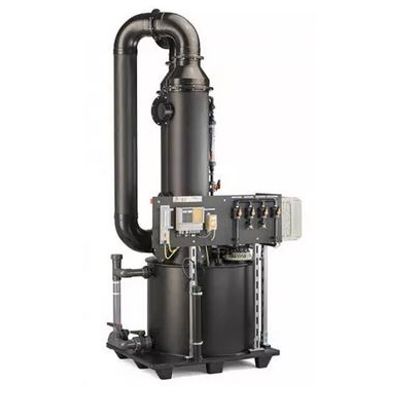
The exhaust air scrubbers have two methods of operation – “crossflow” or circulation. In the crossflow method, fresh scrubbing liquid is constantly introduced, whereas the circulation method uses a pump to introduce the scrubbing liquid repeatedly in a cyclical process until it reaches a certain degree of saturation.
In the crossflow method, volatile substances that are soluble in water, such as alcohols, are used for absorption. In contrast, the circulating method is used primarily for chemisorption. In this method, air pollutants react with chemicals in the scrubbing liquid (e.g., the reaction of ammonia, NH3, and sulfuric acid, H2SO4, to create ammonium sulfate, (NH4)2SO4). The resulting product is soluble in water and accumulates in the scrubbing liquid. Depending on the process – via time control or concentration levels – a part of the scrubbing liquid is removed and replaced by fresh scrubbing liquid.
- A PLC (programmable logic controller) for operating the exhaust scrubber automatically
- Continuous or intermittent removal of the scrubbing liquid via PLC
- The exhaust scrubber, made from synthetic PE/PP or 1.4301 stainless steel
- Tower packing/nozzle holder (horizontal or vertical model)
- A demister
- A circulation pump/dry-run protection
- Temperature, pH, and pressure displays
- A pH regulation pump, a cleaning agent pump
- Installation of the exhaust scrubber in a 20” container
- Conductivity meter
- Flow meter
- Exhaust air containing ammonia, sulfur water, or dimethyl sulfide
- For sulfuric acid precipitation