


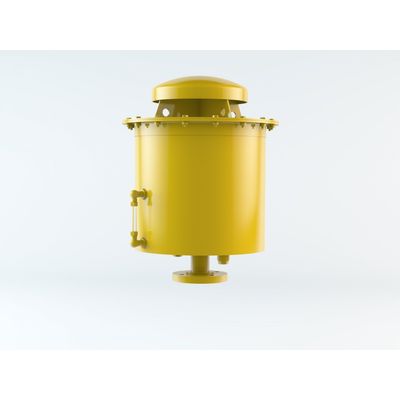
Mueller - Model VTSPC -Packing Case Vent Mist Extractor
The Mueller Model VTSPC Packing Case Vent Mist Extractor effectively removes entrained lubricating fluids from venting natural gas over a wide range of discharge exhaust flows. With no moving parts, the VTSPC is highly reliable and has been widely field proven over the years. As natural gas and lubricating fluid enter the VTSPC via the inlet nozzle, flow impinges on two distinct stages of separation, removing the entrained fluids, with only clean gas ultimately venting to the atmosphere.
The VTSPC is the only product on the market specifically designed to solve one of the most common problems inherent in the natural gas compression process. To minimize wear, lubrication is forced into the engine cylinder and rod packing. Even when that packing is new, gas vents at a rate of about 6 to 10 SCFH, carrying with it a small amount of oil. As the packing wears, additional gas and lubricating fluid vent to the atmosphere. The unsightly oil film on many compressor buildings and grounds is evidence of this environmental pollutant. The VTSPC has reliably eliminated that problem in hundreds of facilities across North America.
In new or overhauled compressors when gas is venting between 6 to 10 SCFH, the 1st stage separating element acts as a coalescer, working on the principle of directional change. Gas and lubricating fluid flowing through the coalescer element repeatedly change direction. Lubricating fluid is caught on the knitted wire of the mesh pad and flows down to the bottom of the element where it is held in place by surface tension. Eventually, the coalesced lubricating fluid becomes a large enough droplet to overcome both the surface tension and upflowing gas velocity and falls into the liquid holding sump.
When rod packing begins to wear, flow increases proportional to the wear. Under these conditions, the first stage separating element acts as an agglomerator. Lubricating fluid continues to be caught on the knitted wire of the mesh pad but now flows to the top of the element due to the increased upflowing gas velocity. As packing wear worsens, flow continues to increase, carrying the agglomerated lubricating fluid to the 2nd stage centrifugal separator. The centrifugal separator slings the liquid particles to an inner shell wall where, due to sheeting action, the lubricating fluid flows into side wall traps and is carried between the inner and outer shell where, due to gravity, it falls into the liquid holding sump
- Field proven for years over a wide range of conditions
- Engineered and constructed for low maintenance and durability
- Low-pressure drop
- No moving parts