


- Home
- Companies
- Pagani Geotechnical Equipment s.r.l.
- Products
- Pagani - Field Vane Tester
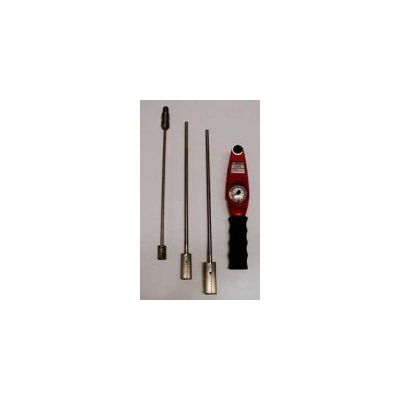
Pagani - Field Vane Tester
This test enables the direct measurement of the undrained shear resistance of saturated cohesive soils. It can be carried out either in the field, on the wall or at the bottom of an excavation, or even in a laboratory on a confined specimen. The test consists of forcing into the soil a vane equipped with four orthogonal blades and then rotating until the soil failure. Maximum torque value must be measured and recorded.
Afterwards the remoulding shear resistance of the soil can be measured rotating the vane for several turns.
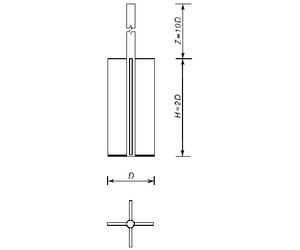
The vanes have a rectangular shape and a height double their diameter, according to the recommendation included in the EUROCODE 7 (1977) and ASTM Standard Code (D 2573); in the latter one also vanes having a tapered end are allowed.
The above mentioned codes prescribe that the rotation must be carried out at a rate of 0.1-0.2 degrees/sec., that is (6–12 degrees/min).
Over the blades of the vane, a thin enlarging ring can be applied so that the main part of the resistance due to the soil friction along the tract of the rod inserted into the soil does not affect the measures.
Tests can be also carried out at the bottom of a borehole; in this case the vane must penetrate at least five times the hole diameter into the soil below the bottom of the hole to be sure that undisturbed soil will be tested (ASTM D 2573).
Test is carried out as follows:
- push the rod supporting the vane to the estimated test depth;
- rotate the vane from the surface at the prescribed rate, using the relevant torque wrench;
- Measure the maximum torque required to reach the soil failure and Go on rotating regularly the vane for at least 3 complete turns measuring and recording the residual torque.
To carry out deep vane tests with the Pagani Geotechnical Equipment static or dynamic penetrometers the following procedure is suggested.
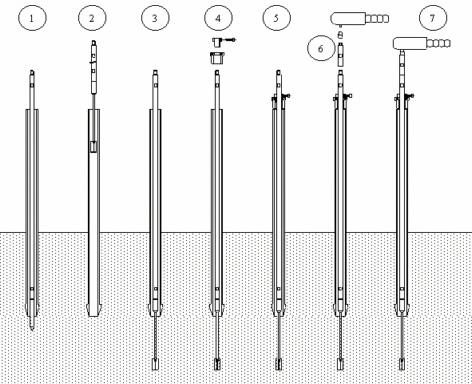
- Drive the piezocone and its casing tubes till the depth next to that of the test.
- Perform a static test (CPT-CPTU) up to the depth close to where the vane test has to be carried out; the related steel casing shall be inserted after the penetration of each rod.
- Withdraw only rods and tip, leaving the casing in place.
- Lower the vane joined to the relevant rods and force it below the hole bottom to reach the undisturbed soil.
- Set the thrust bearing among rod and casing. Set the centered sleeve to support the extension rods.
- Lock the screw to fasten extension rods to supporting sleeve.
- Apply the torque wrench.
- Carry out the test.
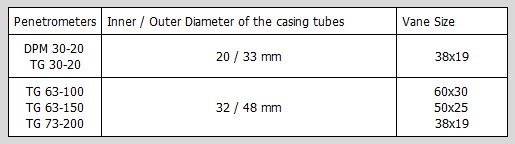
Vanes which can be used together with the different types of casing tubes are the following:
Undrained shear resistance at failure (Su(FV)) is calculated by the maximum torque required to cut the soil included into the cylinder obtained rotating the vane blades.
The general formula, referred to rectangular vanes having height (H) and diameter (D), is:
Su(FV) = T /((p D3/2) (H/D + a/2)) (1)
where:
T = maximum applied torque (deducted any friction).
a = factor depending by the assumed shear stress distribution at the ends of the cylinder obtained rotating the vane blades and amounting to 2/3 for uniform shear stress.
For rectangular vanes having H/D = 2, equation (1) is reduced to:
Su(FV) = 6T / 7p D3 = 0.273T / D3 (2)
The remoulded shear strength value is calculated using the above mentioned formula (2) introducing the value of the torque, free from any friction, measured after some vane rotation turns, that is when the soil offers a fast constant resistance.