


Paques BIOPAQ - Model UASB -Upflow Anaerobic Sludge Blanket
Paques, a global leader in biological wastewater treatment, presents the BIOPAQ UASB system, an innovative technology for the treatment of industrial effluents. Utilizing the Upflow Anaerobic Sludge Blanket (UASB) process, this bioreactor efficiently converts organic compounds into biogas without the use of air. The process significantly reduces effluent discharge costs while simultaneously generating green energy. With the ability to treat diverse effluents from sectors like food, beverage, pulp and paper, and municipalities, the BIOPAQ UASB is highly versatile. Its modular design allows for varying capacities, making it adaptable to any layout requirements. Furthermore, Paques offers a retrofit program to upgrade existing UASB installations, ensuring superior operational stability and longevity. The bioreactor's patented three-phase separator design, featuring multiple gas hoods, minimizes turbulence and facilitates high loading rates, enhancing treatment efficiency across a wide range of applications.
The Upflow Anaerobic Sludge Blanket process is a frequently applied method in the biological treatment of industrial effluents. For decades, Paques has been its global market leader. Nearly four thousand BIOPAQ® UASB modules are in operation worldwide, treating 1,760,000 m3 of effluent per day.
In the BIOPAQ® UASB bioreactor, organic compounds are converted to biogas by bacteria in the absence of air. In this way, effluent discharge costs are reduced and at the same time green energy is produced.
BIOPAQ® UASB technology is applied to treat a large variety of industrial and municipal effluents from food, beer and beverage to pulp & paper, chemical and municipal sewage.
Modular Upflow Anaerobic Sludge Blanket
Paques has standardized the reactor into a modular system. One module has a capacity equivalent to about 1 tonne COD/day (e.g. 15 - 20 m3/hr). This modular approach allows configuring any specific layout and capacity requirement. The modules are available through a worldwide network of licensees.
Retrofit BIOPAQ® UASB
Additionally, a retrofit programme is available for existing UASB installations. Many clients using a low-rate UASB reactor are struggling with the daily operation of their reactor. Over the years, Paques rebuilt and improved many reactors with typical shortcomings in materials, 3-phase separation and/or influent distribution.
Paques not only has a lot of experience in updating Paques’ installations, but also in improving products of other suppliers.. By implementing an UASB® Rebuild in BIOPAQ® design, improvements were made to UASB's from Biothane, Biotim, Degremont and Seghers, by enhancing the operational stability and increasing the lifespan of the installation.
One of the add-ons worth mentioning is the new BIOPAQ® RISE. This external biomass separator is an essential component in an anaerobic system retrofit. BIOPAQ® RISE equips your treatment system for a higher loading rate, improving overall throughput without compromising treatment efficiency. Its unique, space-saving design allows for easy cleaning and easy integration into any setup.
- Very efficient COD removal
- Production of biogas, a sustainable source of energy
- Modular system
- Small reactor height
- Corrosion-free design: ten year guarantee
- Fully accessible for inspection and cleaning
- Closed system: no odour emissions
Characteristic : Influent specification
- COD level : 1,000 to 20,000 mg COD/l
- Loading rate : 10 to 15 kg COD/m3/day
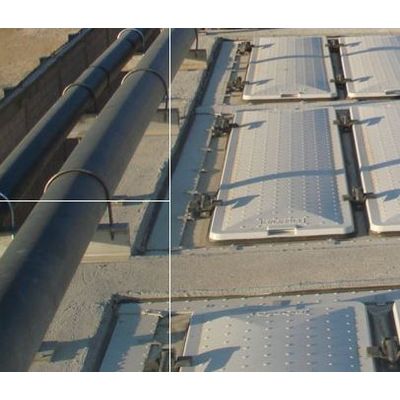
The success of the BIOPAQ® UASB bioreactor is based on the so-called three-phase separator. It enables the reactor to separate gas, water and sludge mixtures under high turbulence conditions. This allows for compact designs.
The patented BIOPAQ® UASB design has multiple gas hoods for the separation of biogas. As a result the extremely large gas/water interfaces greatly reduce turbulence, making relatively high loading rates of 10 – 15 kg/m3.day possible. Separation in the BIOPAQ® UASB requires only 1.0 meter of height, which prevents flotation effects and, consequently, floating layers.