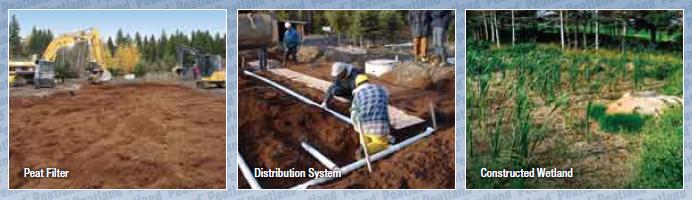

Peatland
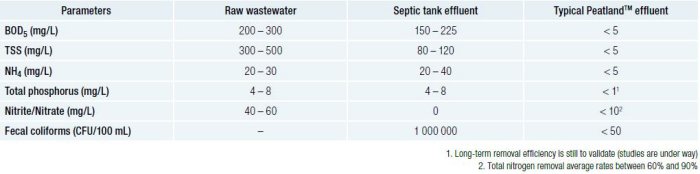
The Peatland treatment system is 100% natural; it is a highly ecological solution that provides optimum treatment in sensitive areas. The system consists of peat moss and a constructed wetland that help remove phosphorus, disinfect effluent and remove nitrogen without adding chemicals or using electromechanical components.
- Flexible, modular design
- Complete biological disinfection
- Easy to integrate into the environment
- Low-cost operation
- Passive system (no electromechanical parts)
- Removes phosphorus naturally, with no added chemicals
A combination of Peatmoss and Constructed Wetland
The PeatlandTM system offers two treatment zones. First, a peat filter with vertical flow in aerobic condition. Secondly, a subsurface constructed wetland with horizontal flow under facultative condition.
The PeatlandTM consists of compacted layers of a special mix of sphagnum peat moss over a layer of granular media. The constructed wetland consists of a layer of selected granular porous media deep enough to create anaerobic conditions, populated with fast-growing native plants showing for a good root system.
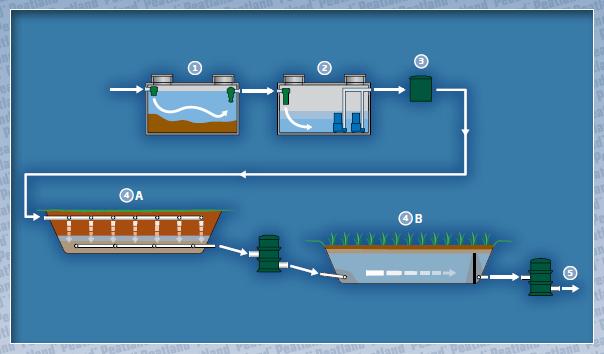
- Primary Treatment
It usually composed of a septic tank, equipped with one or more effluent filters, providing a minimal hydraulic retention time (HRT) of 36 hours at mean daily flow. - Equalization Tank (optionnel)
It provides 12 hours HRT for commercial applications, and 8 hours HRT for community applications. - Pressurized Flow Dividers
They uniformly disperse the wastewater to the distribution pipe network located in the upper part of the peat filter. - A PeatlandTM first treatment zone
Peat filter consisting of compacted layers of hemic sphagnum peat lying on an aggregate layer. The wastewater percolates vertically through the peat media to an underdrain, which leads to the wetland. The main treatment processes in the peat filter are physical filtration, bacterial disinfections, adsorption and aerobic microbiological conversions. - B PeatlandTM second treatment zone
Wetland constructed with a granular, porous media at a sufficient depth to provide generally anaerobic conditions. The wastewater flows horizontally under the surface. The wetland complements the peat filter by providing additional treatment for most parameters, and reducing total nitrogen through a denitrification process. - Discharge
Effluent is finally disposed towards an dispersal zone, a watercourse or a ditch.
- A commercial or community development within an ecologically sensitive area?
- A concern regarding energy consumption?
- Few or no resource available to ensure operation and maintenance?
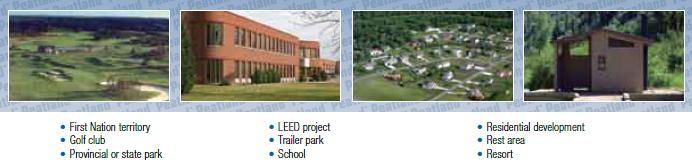
- Achieve high treatment performance
- Minimize your electrical power consumption
- Favor sustainable development
- Accommodate existing site configuration