


- Home
- Companies
- Pennram Diversified Manufacturing ...
- Products
- Pennram - Automatic Loader System
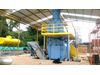
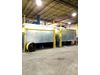
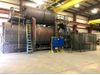
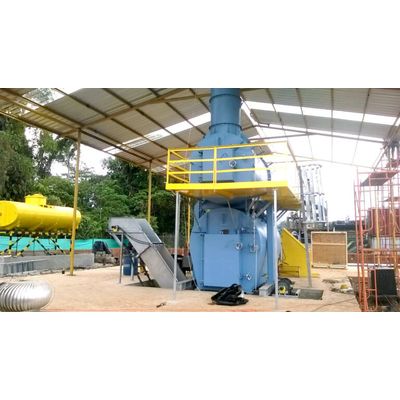
Pennram - Automatic Loader System
Current environmental regulations require that, while charging, the incinerator must maintain controlled air condition and there must be no fugitive emissions from the unit. Pennram automatic hydraulic loaders, designed for fully automatic operation with necessary interlocks, not only meet these requirements, but also greatly improve operator safety and reduce the operating labor needed for the charging operation.
Pennram automatic loaders are of a heavy steel construction. The entire ram assembly is made of A36 ‘” (6.4mm) carbon steel plates, shapes and tubes. The internal plates and tubes are all tied into each other and the exterior surfaces of the charge ram to complete a very rigid structural component able to withstand the mechanical and thermal stresses of tens of thousands strokes in and out of the incinerator. The charge ram is connected to the hydraulic ram shaft at the center point of its face. The charge ram is driven by two opposing hydraulic cylinders “piggy-backed” together.
A refractory insulated firedoor is provided to isolate the waste from the primary chamber. The firedoor is designed to allow waste to lay directly against the door without melting, smoldering, or catching fire. This configuration allows the cold side of the door to stay below 130 degree F (55 degree C), while the primary chamber is continuously operated at 1,500 degree F (816 degree C).One of the most important features of Pennram loaders and primary chambers is that they do not leak air. Air leakage into the primary chamber, which is operated under a slight negative pressure, is the number one problem with many incinerators, as excess air in the primary chamber makes it difficult to control the temperature.
The “charge” operation is initiated by the operator pushing the “charge” push-button. The ram feeder is then set in motion by the closing of all charge interlocks, which include time, temperature, proper exhaust conditions oxygen concentration, or opacity), and safety interlocks. Once all the charge interlocks are satisfied, the following sequence takes place:
- Firedoor fully opens.
- Charge fully extends (waste is pushed by into the primary chamber).
- Charge ram retracts to a position clear of the firedoor and stops.
- Firedoor fully closes.
- Charge ram fully retracts.
- Hopper lid opens.
All components prove position before continuing the sequence. An adjustable water spray is initiated when the firedoor closes. If the system has ash rams, the rams cycle prior to the charge sequence. If there is more than one ash ram, the lowest ram cycles first.