


Pensky Martens - Flash Point Tester (FPM)
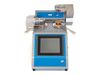
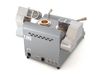
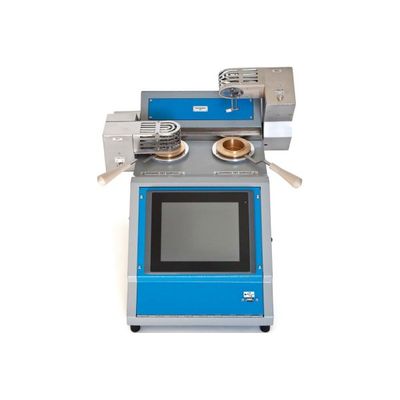
The Ducom Pensky Martens Flash Point Tester (FPM) provides accurate and secure flash point testing to determine volatility and flammability of fuels, lubricating oils and other petroleum products. The FPM is an automatic system capable of conducting the Pensky-Martens closed cup flash point testing. It comes with an integrated touchscreen interface that makes the system very easy to use.
About the Pensky Martens Tester
ASTM D93 Compliant
This test method covers the determination of the flash point of petroleum products in the temperature range from 35 to 360°C.
Procedure A is applicable to distillate fuels (diesel, kerosene, heating oil, turbine fuels), new lubricating oils, and other homogeneous petroleum liquids not included in the scope of Procedure B.
Procedure B is applicable to residual fuel oils, cutback residual, used lubricating oils, mixtures of petroleum liquids with solids, petroleum liquids that tend to form a surface film under test conditions, or are petroleum liquids of such kinematic viscosity that they are not uniformly heated under the stirring and heating conditions of Procedure A.
MEASURING PARAMETERS
- Temperature: °C/°F
- Measuring Range: 0°C to +420°C
- Resolution: 0.01°C
- Accuracy: ±0.1°C
- Repeatability/Reproducibility: as per standard methods or better
TEMPERATURE MEASUREMENT
- Sample Temperature: stainless steel, corrosion and shock-resistant PT100 sensor
- Bath Temperature: PT100 sensor
DIMENSIONS AND WEIGHT
- 37 x 52 x 32 cm, 30 kg (WxDxH)
ELECTRICAL SUPPLY
- 220V ± 15% / 50 to 60 Hz (or) 115V ± 15% / 60 Hz
ASTM TEST METHODS
- ASTM D93: Standard Test Methods for Flash Point by Pensky-Martens Closed Cup Tester
- Procedure A: Applicable to distillate fuels (diesel, biodiesel blends, kerosene, heating oil, turbine fuels), new and in-use lubricating oils, and other homogeneous petroleum liquids not included in the scope of Procedure B or Procedure C.
- Procedure B: Applicable to residual fuel oils, used lubricating oils, mixtures of petroleum liquids with solids, petroleum liquids that tend to form a surface film under test conditions, or are petroleum liquids of such kinematic viscosity that they are not uniformly heated under the stirring and heating conditions of Procedure A.
- Procedure C: Applicable to biodiesel (B100). Since a flash point of residual alcohol in biodiesel is difficult to observe by manual flash point techniques, automated apparatus with electronic flash point detection have been found suitable.
DIN, IP, ISO METHODS
- DIN EN 22719: Petroleum Products and Lubricants - Determination of Flash Point by the Pensky Martens
- IP 34: Determination of Flash Point - Pensky Martens Closed Cup Method
- ISO 2719: Determination of Flash Point - Pensky-Martens Closed Cup Method
- Integrated Touchscreen Panel PC: 8.4-inch, TFT/LCD, high-resolution display
- Storage Capacity: save and store data files in an Excel-compatible format
- User-Friendly Software Interface: automated, temperature-controlled testing
- Advanced Safety Features: automated diagnostics, fire detection system and overheating protection
- Gas valve closes gas supply (30 mbar max.) at the end of the test
- Automated diagnostics of PT100 probe and thermal sensors
- Automatic fire detection and fire extinguisher systems
- Ionization and thermal detectors combined into one multi-detection system