


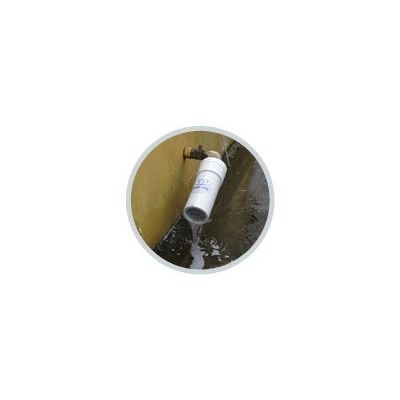
SPI - Model PIFH-616 -Petro Pipes
When a high water table, poor-draining soil or other factors make vertical drainage into the ground difficult or impossible, discharge of water from a containment area can still be accomplished horizontally through a Petro-Pipe. In these cases, a berm, curb or wall can be installed to hold back rainwater that might also contain oil. Installing several Petro-Pipes through concrete, asphalt or earth will trap the oil while allowing uncontaminated water to pass through.Since water drainage works best vertically due to gravity, a Petro-Pipe is not as efficient at moving water as a Petro-Barrier. Therefore, more surface area is required when using Petro-Pipes than when using vertically draining barriers. A 25-degree minimum slope from inlet to discharge is recommended for flow rates of 2.5 to 3 gallons per minute.
Petro Pipe is Highly Customizeable
Petro-Pipes® are available in a variety of sizes according to drainage need. They are adaptable to valves, drains, through walls and through a variety of piping.
Easy Installation
Petro-Pipes® are easily replaced by swapping out a new Petro-Pipe® insert from within a pre-cast flanged outer sleeve. Stainless steel bolts and a gasket ensure the integrity of the flanged joint seal.
The above drawing is the PIFH-616 Petro-Pipe with a 7” flanged ID housing and can to be cast into a concrete wall, attached through a liner or other type of containment berm. The Petro-Pipe is a 6” flanged ID and slides into the housing pipe and attaches with 5 stainless steel screws, there is an o ring on the underside of the 6” Petro-Pipe that when the screws are tightened the O-ring makes a water/oil tight seal.
Petro-Pipe 6" X 16" Long Flanged with 7" Flanged Housing Pipe
The PIFH-616 Petro-Pipe is used for rainwater discharge from oil containment areas. The 7” housing pipe is flanged and is mounted through the liner or containment wall. The housing pipe is best when installed on a 15 - 25 degree slope allowing water to build up on the face of the Petro-Pipe providing positive head pressure for optimum flow of 3 to 3.5 gpm.
The Petro-Pipe is installed into the housing and is attached with 5 stainless steel screws. There is an o-ring between the flanges that is compressed when the screws are tightened creating an water/oil tight seal.
In a liner application there is an additional flange that is attached to the liner prior to installing the housing pipe. This flange provides complete sealing of the liner to the Petro-Pipe.
Petro-Pipes have a retaining ring on the inside that is removable and a dirt filter is accessible. The dirt and debris filter keeps the Petro-Pipe free of dirt and requires checking usually once per year. Petro-Pipes allow for point discharge so they can be changed out and filters cleaned.
The PIFH-616 Petro-Pipe for best operation is installed on a 25 degree slope. The concrete is cut out on an angle which allows all the rain water to drain off the containment area floor into the Petro-Pipe also providing water head pressure for better drainage. The Petro-Pipe can also be installed in a trench that allows all the rain water to drain into the trench also providing head pressure to the Petro-Pipe. Since the Petro-Pipes are passive gravity draining the water head pressure increase their flow rate to a maximum of 3.5 to 4 gallons per minute.
The above picture shows the Housing and Petro-Pipe installed on the correct 25 degree slope through the concrete wall.
The Petro-Pipe housing is installed through the concrete at the correct angle and the concrete is cut out allowing all the water to enter the Petro-Pipe
There are many ways Petro-Pipes can be used in oil containment areas for water drainage. The uniqueness of Petro-Pipe is they work passively draining water 24/7 keeping containment areas free of water and protected from an oil spill. Petro-Pipes come in different sizes and can either be cast in concrete or liners or even bermed areas, or they can come with male or female fittings and can be used with or without ball valves. The following drawings will show just a few ideas on how these products can be used to save time and money on maintenance or disposal of oily water.
Petro-Pipe used in Horizontal Applications
Horizontal use of the Petro-Pipe is acceptable in where a pre-filter cage is used and the Petro-Pipe is placed is a sump or trench. This allows the water level to build up on the face of the Petro-Pipe providing head pressure. Without the head pressure the Petro-Pipe does not flow well. Draniage is about 1/3 that of a Petro-Pipe installed on a 15 - 25 degree slope. The use of crushed stone is a great additional dirt filter.