


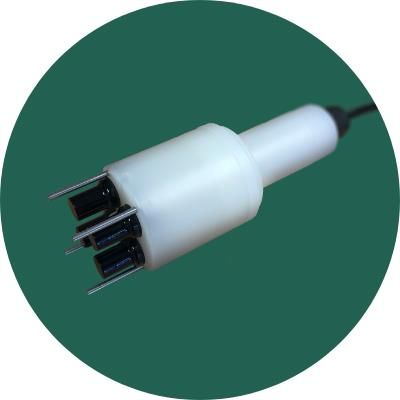
Phathom - Model T30-SWW -Suspended Solids and Turbidity Sensor
Designed for accuracy in clean water, measuring a TSS range of 0 – 0.75 g/L (SiO2) and a turbidity range of 0 – 1,000 NTU. The T-series are immersion sensors and they use nephelometry (90 degree scattered light) and direct attenuated light to measure both TSS and turbidity directly.
Get better control and monitoring of your Stormwater run-off, Sediment, Raw Water and Surface Water. Bringing sophisticated process control suspended solids sensors to Stormwater and Waste
Four beam self compensating sensor, virtually eliminates drift due to contamination or electronic ageing.
- Immersion style.
- Simple user interface.
- Accurate, repeatable & reliable.
- Low power suitable for remote installations
- Connects directly with 4-20mA and Modbus RS485, or SDI-12
T30-SWW Measurement Range, 0 to 1000 NTU, 0 to 750mg/l SiO2
Multi-beam sensor using both attenuated and 90° scattered light. The multi-beam system compensates for fouling of surface and ageing of electronics providing a very repeatable output.
Applications include:
- Stormwater sediment runoff monitoring
- Flocculant dosing and control
- Wastewater monitoring and control
- Monitoring of clarifier overflow weirs
- Raw water inlet turbidity measurement to water treatment plants
- Surface water monitoring
- Solids loading in rivers and streams
- Final outlet of effluent from DAF plants
- Filtration Monitoring and control
Measuring Range
- Immersion Sensor:
- 0 to 1000 NTU
- 0 to 750mg/l SiO2 (the measuring range will vary according to media and particle characteristics)
- Accuracy: +/- 2% of reading
- Repeatability: +/- 1% of reading
- Temperature: 0 to 50°C operating range
- Pressure: 5 Bar
- Cable:
- Polyurethane covered cable rated to 95°C.
- Extension cables can be supplied to extend the cable up to 100m.
- Outputs: Modbus RS485, 4-20mA and 1 x solid state relay or SDI-12 only
- Power Requirement:
- Modbus only - 0.25W at 3.7V
- 4-20mA and Modbus - 9 to 32V DC
- SDI-12 - 0.1W (working), 0.002W (asleep) at 3.7 to 32V DC
Model Number Selection Guide
- Body Style: T30-SWW - Immersion Body
- Wave Length: 880nm - Standard.
- Body Material: PP - Polypropylene, Fingers - Polysulfone
- Cable: 10- Supplied with a 10m cable as standard. Other lengths available
- Output: MB - Modbus RS485, or SD - SDI-12
- Jet Nozzle: Requires water or airflow. Air to 5 Bar
- Sample model no: T30-SWW-880-PP-10-MB
- Calibration: Shipped with PC based App and USB Dongle
Buy your sensor or build your monitoring system
Phathom sensors will work with a 3.7V battery recharged by solar panels, making them ideal for remote deployment.
Phathom sensors can be connected to a local power source.
Phathom sensors will work with a 9-32V battery supply, making them ideal for remote deployment.
You can integrate a Phathom sensor into your existing telemetry through either a 4-20mA, Modbus RS485 or SDI-12 connector. Or click right to see examples of tried and tested systems.
They are leaders in agri-data. Phathom sensors work well with their telemetry solutions.
Industrial communications and data
Instrumatics’ economical communications unit and platform
Gold standard sediment control monitoring
Flotation buoys and devices support Phathom sensors in ponds, estuaries, and larger rivers.
Phathom sensors can be secured outside of the water and immersed into the water in a flume, sump, tank, lift stations or body of water.
Phathom sensors can be integrated into a plumbed system for clarifiers, lamellas, dewatering systems or raw water supply.
Unlike single-beam sensors that require constant cleaning, Phathom sensors typically only need occasional cleaning at most because their multi-beam technology self-compensates for accumulated dirt unless they get completely clogged. That means they usually don’t require any attachment.