


- Home
- Companies
- Photonic Lattice, Inc.
- Products
- Photonic Lattice - Photonic Crystal ...


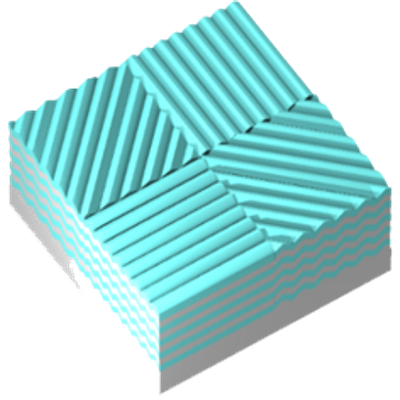
Photonic Lattice - Photonic Crystal Polarizing Optical Components
Photonic Crystal Polarizing Optical Components are engineered to offer precise polarization control over a wide wavelength range from deep ultraviolet to near-infrared (250nm to 1600nm). The components feature exceptionally accurate axis orientation control, allowing for fine-tuning over small areas as tiny as 1μm. Constructed from inorganic materials, these components are capable of withstanding high optical powers and demonstrate remarkable heat resistance with minimal temperature dependence. The inclusion of optional anti-reflection coatings limits absorption and diffusion, enhancing transparency. True-Zero Order phase plates support applications demanding minimal wavefront distortion, and customizability extends to adjusting optical properties, shapes, and distribution patterns, creating segmented or curved structures. These components are suitable for various applications such as optical communications, laser processing, and optical tweezers.
Operating Wavelength ranging from DUV to near Infrared
Operating wavelength can be chosen in the 250nm~1600nm range, for which we provide an optimal design given our customer requirements (specs).
Very Precise Control of Axis Orientation
We provide very accurate control for axis orientation of polarizers and waveplates, which can be tuned finely over the surface, in areas as small as a 1μm.
High-Power High Heat Resistance
The components are made of inorganic materials, making them very resistant to high-power light input. They are also heat-resistant, having almost no temperature dependence.
Outstanding Optical Properties
With optional Anti-Reflection (AR) coatings, the elements exhibit very small absorption & diffusion, while providing high transparency. Moreover, phase plate elements are True-Zero Order, making them ideal for applications requiring small wave front perturbation, while providing very small dependence on incident angle.