

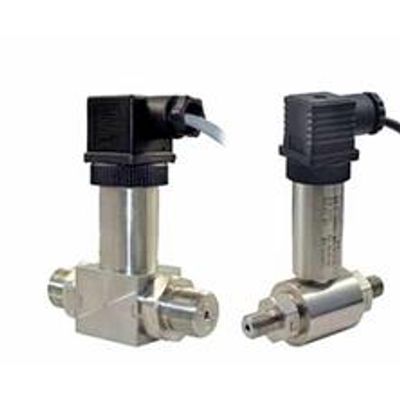
Sino-Inst- - Model SI-801 -Piezoresistive Differential Pressure Transmitter
Piezoresistive Differential Pressure Transmitter uses integrated all-welded differential pressure measuring elements. Silicone oil is filled between the chip and the two corrugated diaphragms. This product utilizes the piezoresistive effect of semiconductor silicon materials. To achieve the conversion of differential pressure and electrical signals. The signal output from the Wheatstone bridge on the sensitive chip has a good linear relationship with the differential pressure. Therefore, accurate measurement of the measured differential pressure can be achieved. It is suitable for differential pressure measurement of various gases and liquids in petroleum, chemical.
Working Principle of Piezoresistive Differential Pressure Transmitter
The sensitive element of the piezoresistive differential pressure transmitter is a solid piezoresistive sensitive chip. Silicone oil is filled between the chip and the two corrugated diaphragms.
The measured differential pressure acts on the corrugated diaphragms at both ends. The differential pressure is transmitted to the sensitive chip through silicone oil. The sensitive chip is connected to the special amplifier circuit through the wire. It utilizes the piezoresistive effect of semiconductor silicon materials.
To achieve the conversion of differential pressure and electrical signals. The signal output from the Wheatstone bridge on the sensitive chip has a good linear relationship with the differential pressure.
Therefore, accurate measurement of the measured differential pressure can be achieved. It is used to measure the pressure difference of various gases and liquids. It is suitable for the measurement of differential pressure and water level difference of pipelines in petroleum and chemical industries.
The Piezoresistive Effect
The so-called piezoresistive effect refers to the phenomenon that when the semiconductor is subjected to stress, the energy band changes due to the stress, the energy of the energy valley moves, and its resistivity changes.
It was discovered by C.S Smith in the 1954 test of the resistivity and stress change characteristics of silicon and germanium. Semiconductor piezoresistive sensors have been widely used in aviation, chemical, marine, power and medical sectors.
Strain pressure sensor VS piezoresistive pressure sensor
In principle, strain-type pressure sensors are caused by changes in the geometry (length or width) of the strained material caused by external pressure (or tension). This in turn causes the resistance of the material to change. The magnitude of the external force can be measured by detecting this resistance change.
Piezoresistive pressure sensors are usually semiconductor pressure sensitive materials. After the semiconductor piezoresistive sensor is subjected to external forces, its own geometry hardly changes. Instead, its lattice parameters change, affecting the width of the forbidden band. Even a very small change in the width of the forbidden band will cause a large change in carrier density. This eventually causes the resistivity of the material to change.
It can be seen that although both materials exhibit changes in resistance to changes in external force, the principles are different. In addition, the sensitivity of strain-type materials to external forces is much lower than that of semiconductor piezoresistive materials.
The sensitivity of the latter is about 100 times that of the former. The characteristics of strained materials are less affected by temperature. Semiconductor piezoresistive materials are sensitive to temperature.
- All stainless steel structure design;
- Small size, light weight and easy installation;
- Welded structure, fully sealed;
- Enclosure protection grade IP65;
- The sensor is a diffused silicon piezoresistive differential pressure sensor, stainless steel 316L isolation diaphragm;
- After temperature compensation and aging screening, the performance is stable and reliable;
- Connector type products can adjust the zero point and fullness externally;
- Range: 0 ~ 10KPa ~ 35MPa
- Withstand voltage: three times the range value
- Comprehensive accuracy: 0.2% FS, 0.5% FS
- Input and output signals: 4-20mA (two-wire system), 0-5 / 1-5 / 0-10VDC (three-wire system)
- Supply voltage: 24VDC (10-30VDC)
- Medium temperature: -20 ~ 65 ℃
- Ambient temperature: -20 ~ 65 ℃
- Load resistance: Current output type: maximum 800Ω; voltage output type: greater than 50KΩ
- Insulation resistance: Greater than 2000MΩ (100VDC)
- Sealing grade: IP65
- Long-term stability: 0.1% FS / year
- Vibration effect: Within the mechanical vibration frequency 20Hz ~ 1000Hz, the output change is less than 0.1% FS
- Electrical interface: Hessman connector ( Support customization)
- Mechanical connection (thread interface): M20 × 1.5, G1 / 2
- Flow measurement
- Wastewater treatment
- Wind Diff Pressure undermine
- Water Diff Pressure at hydropower station
- urban flood control and waterlogging prevention
- Underwater engineering
- Groundwater monitoring
- Central air-conditioning terminal control
- Watersaving Irrigation
Advantages of piezoresistive pressure sensor:
- High frequency response, f0 can reach 1.5M;
- Small size and low power consumption;
- High sensitivity, good accuracy, can measure to 0.1% accuracy;
- No moving parts (the sensitive element is integrated with the conversion element).
Disadvantages of piezoresistive pressure sensor:
- Poor temperature characteristics;
- The process is complicated.