


- Home
- Companies
- Biologia y Filtracion S.L ( Bio-Fil )
- Products
- Biofill - Model Type C & CT - Plastic ...
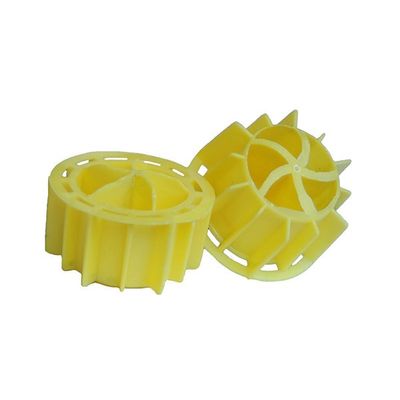
Biofill - Model Type C & CT -Plastic Media
BIOFILL type C is the first product created by our Technical Department for fluidized bed biological systems (MBBR) with fixed biomass, either aerobic or anaerobic. This product, installed in many treatment plants, is excellent for enlargement of treatment plants where the load is increasing over the original design. The plastic media BIOFILL type C was developed in 2005 in collaboration with departments of the Polytechnic University of Catalonia and the CSIC. The design of the media is conceived to allocate a great amount of biomass in its surfaces (internal and external) and cavities, producing an important performance enhancement in the treatment it will be applied on.
It is made in two versions:
- type C , with density below 1
- type CT , with density over 1
Their areas of application are many:
- Moving beds (MBBR), for the enlargement of municipal or industrial wastewater treatment plants.
- Treatment plants for residual agriculture waters (collecting and canning plants for legumes, tubers, vegetables and fruit).
- Aquiculture (fish farms in general). This segment also includes regeneration of lagoons, rivers and subterranean waters.
- Anaerobic treatment and others.
- Exchange towers (chemical exchange, gas cleaning, odor elimination).
- Specific surface : > 460 m2/m3
- Free volume : 90
- No of pieces/m3 : 75.000
- Piece diameter : 25 mm
- Weight per piece : 1,7 gr
- Weight per m3 standar : 127 Kg
- Weight per piece BIOFILL® CT : 1.8 gr
- Weight per m3 BIOFILL® CT : 133 Kg
- Made by injection in : PP and PET
- Compression : 0 cm/500Kg
- Max. working temperature : 65 °C
- Resistance to hydrocarbons : Good
- Resistance to alkalis : Excellent
- Collocation : Random
The advantages that our product has compared to other ones existing:
- It is a product made by injection.
- Curvilinear forms and micro concavities that retain the water drops for long time.
- Promotes biomass grow, which is fixed on the concave and rough walls of each piece.