


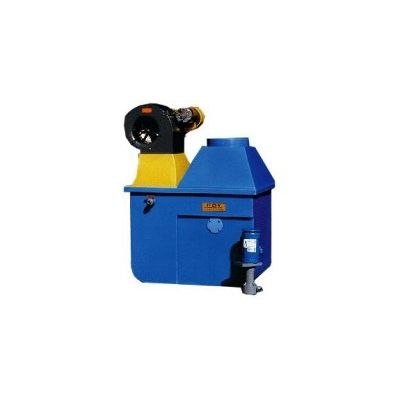
Poly Products - Evaporative Tank
The Poly Products Evaporative Tank is available in two models, the ET-II-W and the ET-III-W. Each of these are ideally suited for dewatering spent solutions or wastewater that may have a high solids content. The evaporation mechanism eliminates any small, entrapping passages. Up AND down-draft spraying at very high flow rates produces high evaporation at moderate temperatures.
Those looking for the greatest evaporation rates at a given temperature will choose the Evaporative Tank-III-W for its high efficiency for any application.
A specialty use for the Evaporative Tank-III-W is the dewatering of decorative and hard chrome. The Evaporative Tank-III-W can be used directly on the plating tank to remove rinse spray water and fume scrubber water.
Dewatering of waste solutions (cutting oils, printing ink & paint washwater, spent chemical solutions, parts cleaning, DI & RO regeneration waste, air scrubber waste, air compressor condensation, ink and dyes) save the users of Evaporative Tank-III-W evaporators thousands of dollars in disposal costs. Where the need is for only 3 to 4 gallons of evaporation per hour, no added heat is required. Heat for evaporation is taken from the room.
See the Evaporative Tank Companion - a condenser that dries the air and separates the water, to be reused in the process.
- Waste Water Treatment
- Industrial Evaporation
- Chemical Evaporation
- Oily Water Evaporation
- Plating
- Aggresive Solutions
The EVAPORATIVE TANK™ is available in two models: The ET-II-W and ET-III-W. Both are ideally suited for dewatering spent solutions or wastewaters that may have a high solids content.
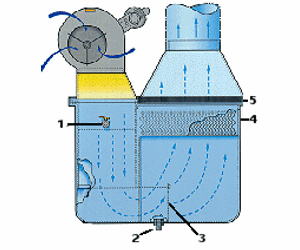
Pumped solution is circulated at a high flow rate from your process tank, heated tank or reservoir up to the ET-II-W or ET-III-W and is drained back by gravity to your tank, but returning with less water.
In the evaporator, the solution is sprayed into large droplets. These droplets provide a tremendous amount of surface area that will come in direct contact with the incoming air. Heated solutions will in turn heat the air; warm air can hold more water volume then cool air. The warmer the solution, the warmer the air, the better your evaporation rate.
The humid air is then ducted to the outdoors, or into the Companion Condenser if so equipped (see "condenser" section of web site). Heat for evaporation is taken from the solution pumped through the evaporator (about 9,000 BTU per gallon per hour of evaporation).
The proprietary "triple-effect" of the Mist Eliminator reduces droplet emissions to a very low level by impinging mist out of the airstream in three sequential tight bends in the air path. The impinged droplets fall back into the Evaporator so that the clean air can continue out through the exhaust. The Poly Products evaporators are EPA compliant with only the standard Mist Eliminator, but an optional AirScrubber™ (Mesh Pad) can be installed inside the EVAPORATIVE TANK™ at any time to further reduce emissions by another 98% to meet the most stringent regulations.
The Poly Products model ET-III-W is the most versatile evaporator in existence; it can evaporate in a clean laboratory setting to a harsh industrial environment. The ET-III-W can evaporate at room temperatures with no added heat at a evaporation rate of *3-5 GPH or as high as *60 GPH at our maximum temperature of 160 deg f.
Waste Water Minimization
The Poly Products Atmospheric Evaporator will reduce waste water volumes easily at ambient to moderately low temperatures making Poly Products the safest way evaporate your waste water. Large tanker truck volumes can be reduced to just a few drums, once evaporated. This is a significant savings in your haul off costs. The ET-III-W has large wide open passageways making Poly Products the ideal choice for minimizing your waste volumes. When a full scale waste treatment system seams to be out of reach or just to large for your needs, think Poly Products for Evaporation.
Non-Contaminating Recovery
Natural (Atmospheric) evaporation uses no resins, membranes or electrolytic plate-out cells that require high maintenance and replacement costs. Since no chemistry is added or removed, your process remains unchanged, and that make the Poly Products evaporator ideal for recovery and recycling applications.
Simple and Easy to Use
Control for the ET-III-W Evaporator can be as easy as an ON/OFF breaker box on the wall. Even the fully automated Heated Tank Systems are user friendly; just press the start button and let the control panel monitor temperature and level control and notify you when the cycle is complete.
Low Maintenance
The EVAPORATIVE TANK ™ uses only two moving parts - a pump and low cost blower. All molded polyethylene components are molded as one piece with NO WELDED SEAMS for solution security. The tank thickness is approximately 1/4" to 3/8". Other materials used are high-temp CPCV, polypropylene or Teflon, PVC, EPDM or Viton seals, and stainless or Titanium fasteners. The POLY PRODUCTS EVAPORATIVE TANK™ is the ONLY atmospheric evaporator with a lifetime no-leak warranty.
Low Cost
Totaling all costs: initial purchase, energy, maintenance - the POLY PRODUCTS EVAPORATIVE TANK ™ is the most cost effective in recovering 100% of the chemicals (dragout) from your rinse water, or in reducing the volume of spent solution and wastewater. When using natural gas for heat, the cost of evaporation is about $.06 per gallon.
If a bath can be air agitated without causing excessive foam, it should be well suited to this method of recovery or reduction. High cyanide baths and nickels are examples of solutions that should be tested for foaming. A sample can be shaken in a glass jar to see if the foam disappears quickly.
Evaporation eliminates water and leaves all the plating chemicals and tap water impurities in the process tank. If your application is a recovery for reuse process, your recovered bath may need to be filtered or you may want to consider using D.I. or R.O. water in the rinsing chain. If your application is a waste water minimization process, you will accumulate solids that can be collected or filtered with a filter press for further dewatering for solids haul off.
- Recovery/Recycling Methods for Metal Finishers: Article From: Products Finishing, Stephen R. Schulte, P.E. REM from Hixson Inc. A guide to lowering pollution and recovering valuable process constituents.
- Case Study : The Beauty of a Closed Loop: The customer was using a “dead rinse” as well as two additional rinse tanks. We needed to find a way to extend the life of the rinse tanks and to reduce the amount of chrome being introduced to the system.
- Rinsing for Recovery, Efficiency, and Better Work Practical and proven rinsing techniques that ensure high quality standards, minimize the amount of water necessary, and provide for recovery of most, if not all, of the process dragout.
- Rinsing with Less Water: Taking a little time to study your rinsing needs, and devising ways to minimize water usage will pay great dividends.
- Can I Evaporate My Hazardous Waste? If you are not sure if you could or should evaporate your hazardous waste, take some time to review this article for answers from the Ohio EPA.
- Let’s start at the beginning. The ET-III-W™ evaporator has become the choice evaporator for nearly every application throughout America and around the world.