


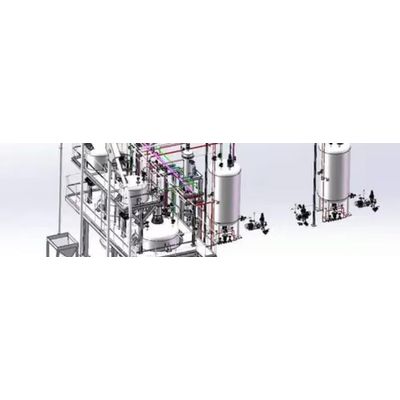
Annular tube reactors (also called loop reactors) are widely used in slurry-phase polyethylene production, including ultra-high molecular weight polyethylene (UHMWPE). The two main industrial processes are:
1. Phillips Single-Loop Process- Developer: Phillips Petroleum (now Chevron Phillips Chemical)
- Reactor Type: Single annular loop reactor with high-speed circulation.
- Key Features:
- Uses chromium oxide (CrOx) or Ziegler-Natta catalysts for polymerization.
- Operates at low pressure (20–40 bar) and moderate temperature (85–110°C).
- No mechanical agitator—polymerization occurs in a continuously circulating loop.
- Isobutane or hexane used as diluent (slurry medium).
- High heat removal efficiency due to turbulent flow.
- Produces monomodal UHMWPE with very high molecular weight (MW > 5 million g/mol).
- Developer: Ineos (formerly BP Innovene)
- Reactor Type: Two interconnected loop reactors in series.
Key Features:
- Uses Ziegler-Natta catalysts (similar to Hostalen process).
- First reactor produces low-MW polymer, while the second reactor builds UHMWPE chains.
- Better control over molecular weight distribution (MWD) than single-loop systems.
- Can produce bimodal UHMWPE (combining high and low MW fractions).
- Higher production capacity than single-loop designs.
The Hostalen process and Mitsui CX process are two prominent slurry polymerization methods used for producing ultra-high molecular weight polyethylene (UHMWPE).
Hostalen Process
- Developer: Hoechst AG (now part of Basell) for HDPE production, later adapted for UHMWPE.
- Reactor Type: Uses two stirred-tank reactors (either in series or parallel) for polymerization.
Key Features:
- Operates at low temperature and pressure, with high flexibility in production.
- Uses Ziegler-Natta (Z-N) catalysts, which are tolerant to impurities in ethylene feedstock.
- Produces bimodal or monomodal UHMWPE depending on reactor configuration.
- Drying step required after polymerization to remove residual solvent.
- Dominates global UHMWPE production, accounting for over two-thirds of capacity
Mitsui CX Process
- Developer: Mitsui Chemicals (Japan).
- Reactor Type: Single stirred-tank reactor with unique heat removal mechanism.
Key Features:
- Relies on solvent evaporation (hexane) for heat removal (accounts for >50% of cooling).
- Uses Z-N catalysts, similar to Hostalen, but with different co-catalyst ratios.
- Lower production capacity compared to Hostalen due to heat transfer limitations.
- No external cooling needed—heat is removed via vaporization of hexane 13.
Ammonia is typically used as a chemical agent for the reduction of nitrous oxide emissions (NOx). Anhydrous ammonia is a highly toxic chemical , which is typically stored in pressure vessels as a liquified-gas. There are significant risks and liability associated with its transport, unloading, and bulk storage. The way to solve this risk is to converts safe and non toxic urea to an ammonia product gas as needed to meet plant process demands - the safe alternative to hazardous transport and bulk storage of anhydrous and aqueous ammonia.