


- Home
- Companies
- Sequoia Scientific, Inc.
- Products
- Sequoia Scientific - Model ...
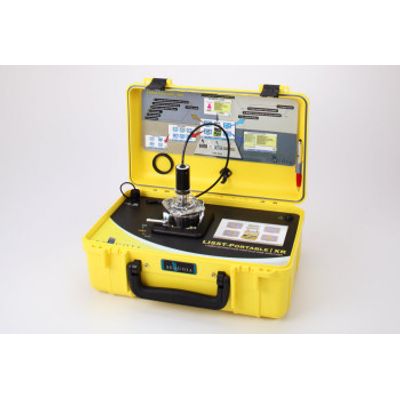
Sequoia Scientific - Model LISST-Portable|XR -Portable Laser Diffraction Particle Size Analyzer
The LISST-Portable-XR is the world’s first and only battery powered portable particle size analyzer. It can be used in the field, in the laboratory or on the factory floor. The LISST-Portable|XR analyzes the sample in a wet state to obtain the particle size distribution and the particle volume concentration. The LISST-Portable|XR uses the same laser light scattering method (laser diffraction) as popular laboratory particle size analyzers.
It has all the features and performance of a laboratory instrument but in a self-contained, portable enclosure that allows you to make measurements where it’s needed, when it’s needed.
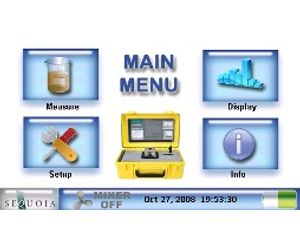
The screenshots below are actual screenshots from the touch panel display on the LISST-Portable.
Programing the LISST-Portable is easy. The Main Menu offers four different submenus. The Sequoia button in the bottom left corner will always return the user to the main menu. When the mixer is running the mixer icon lights and the battery icon displays remaining battery power.
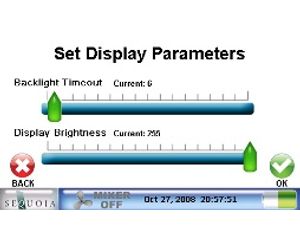
In the Display menu, the user has the option to set the backlight timeout (in order to conserve power) as well as the display brightness by dragging the pointer along on the sliding scale.
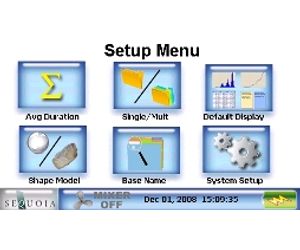
In the Setup Menu, the user can choose between six sub-menus. The Avgerage Duration menu allows the user to set the time (in seconds) that averaging takes place. Note that the LISST-Portable gives the user the option to select a shape model for processing the data. The LISST-Portable is the only particle size analyzer in theworld that gives the user such a choice. This option isselectable on a sample-by-sample basis for maximum versatility.
Once all the parameters have been set, the user can start measuring samples. During sampling, graphical step-by-step instructionsguides the user through the measuring procedure and instant feedback isgiven to the user if the concentration is too high or too low.
Clicking the measure button from the main menu walks the user through the sample procedure step-by-step. The first order of business is to make sure that the mixing chamber is clean and rinse it if it is not.
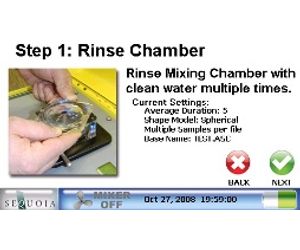
Once the mixing chamber is sufficiently clean, a clean water background (zscat) measurement is obtained and compared to the factory background measurement. Clicking the update button will cause a refresh of the background measurement if the previous one was not satisfactory. A warning is displayed if the background (baseline) measurement is not of sufficiently highquality.
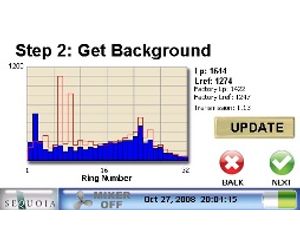
Upon obtaining a satisfactory background measurement the background water can be drained, and the sample introduced into the mixing chamber. The colorbar to the left helps the user decide if the sample needs to be diluted or concentrated in order to obtain the best quality of data. At this stage it is also possible to enter a note regarding the nature of the sample by pressing the grey box.
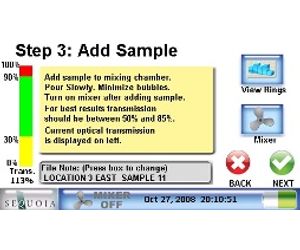
This enables the keyboard where the sample note can be typed in.
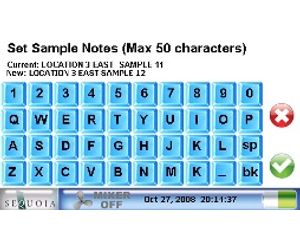
Once the concentration is in range and the optional notes have been entered the instrument will acquire the data, using the averaging duration specified in the Setup Menu. Data are recorded internally at 39 Hz, so averaging over 5 seconds will create an average based on 195 measurements.
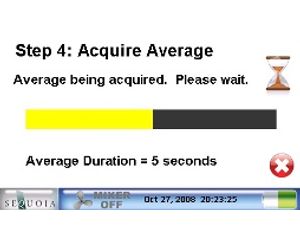
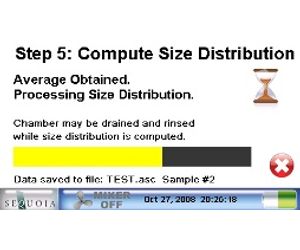
As soon as the average has been obtained the size distribution is computed. This takes 45 seconds and in the meantime the user can drain the mixing chamber and clean it, so that it is ready for the next sample.
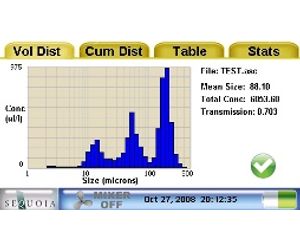
The size distribution is displayed after processing. Clicking the tabs on the top shifts between four different displays.
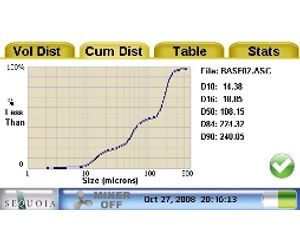
In the Cumulative Distribution plot a number of parameters related to the size distribution are shown as well.
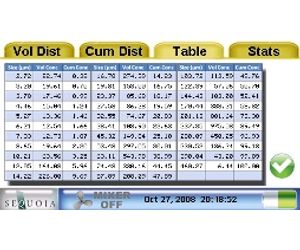
The table shows detailed concentration for each size bin.
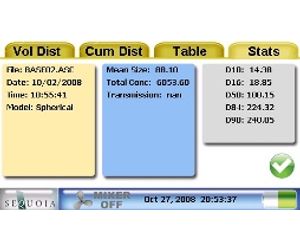
The stats tab has more detailed information and listing of auxiliary parameters. Numerous parameters are computed and stored with the ASCII file, suchas the voluem concentration in each size bin, mean and median (D50) grain size, D10, D90, D16, and D85grain size, standard deviation, surface area, optical transmission,total volume concentration, and the volume concentration in the <64µm size range.
- Truly portable – completely self-contained with built-in data logger, processor, rechargeable battery, and 7” touch panel color display.
- Touch panel allows for easy SOP programming, sample analysis and display of data without a PC.
- Shock mounted optics block.
- Multiple Mie models as well as Fraunhofer model available for inversion, selectable from the touch panel
- All data-processing is performed on board and stored in ASCII format. No post-processing necessary.
- Outputs: Total volume concentration, mean size, standard deviation, optical transmission, D5, D10, D16, D25, D50 (median grain size), D60, D75, D84, D90, D95, D60/D10 (Hazen uniformity coefficient), particle surface area, silt fraction, silt volume, size distribution, battery voltage, sample notes.
- 7″ graphics display; 800 x 480 pixels, 16-bit color
- Self contained with internal data logger and rechargeable battery pack
- All data-processing is performed on board – no post-processing necessary
- Data stored on-board in ASCII-format
- Based on the laser diffraction principle. Compliant with ISO-13320-1 standard.
For more than 20 years, Sequoia Scientific has been making submersible, battery powered laser diffraction particle size analyzers. We have taken the knowledge learned from building submersible instruments and applied it to a truly portable particle size analyzer that is just as happy on a lab bench as it is next to a flowing stream on a rainy day. The LISST-Portable|XR is the fourth generation of LISST-Portable. With this latest generation we have made many improvements to make the instrument easier to use as well as increase the performance such as measuring smaller particles and adding features such as the built-in ultrasonic probe.
Why do I need a portable particle size analyzer?
There are many applications where having a portable instrument is very helpful. Making measurements of samples from a small stream without sample handling issues or measuring drilling fluid on the drill site for faster results are two examples. However, having a portable instrument is also useful even if you only plan to use it in a lab environment. For example, you might have a need to measure particle size at multiple facilities but the cost of laboratory particle size analyzers is too high to justify one instrument at each location. Moving these instruments from place to place is not easy and takes too long. The LISST-Portable|XR can be easily moved from location to location with no setup. Open the lid, turn it on and you are ready to go. When you are done with it, just store it under the bench or in a cabinet until it is needed. The costs in money and manpower for labeling, tracking, transporting, storing, and processing samples can be high. Making measurements right at the source can eliminate these costs while providing instant actionable data.
One of the key features of the LISST-Portable|XR that sets it apart from other particle size analyzers (in addition to being truly portable) is how easy it is to use. Upon powering up the instrument the first thing you will see is the large 7” Touch Screen. This touch screen walks the operator through the process of collecting a measurement and displays the results for immediate evaluation. No computer is require to take measurements or view results. The results are stored on the instrument and can be downloaded later to generate a formal report. The ease of use combined with the configurable standard operating procedures makes it possible to have non-experts consistently and accurately measure particle size.
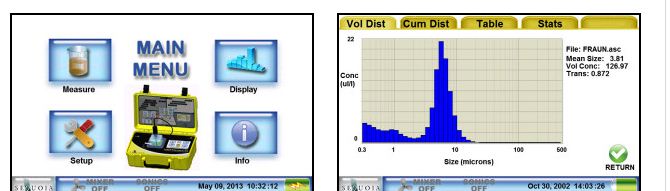
A more detailed introduction to the user interface can be found on the LISST-Portable|XR video page. There are two videos related to the user interface. One is on “How to make a Measurement” and the other is an “Intro to the Main Menu”.
Measurements are saved on-board the instrument and can be viewed on the screen at any time. Connect the LISST-Portable|XR to a PC using the provided USB cable to offload the processed results. Using a customizable Excel template a formal size distribution report can be generated and printed or saved as a PDF. An example of the Size Distribution Report can be found here.
The core technology used by the LISST-Portable|XR is laser light scattering or laser diffraction. This method is one of the most common ways of measuring particle size. There are many companies using this method including Malvern, Horiba, Cilas, and others. The performance of the LISST-Portable|XR is equal to the laboratory instruments but in a completely portable package. The LISST-Portable|XR is compliant with the ISO-13320-1 standard for laser diffraction measurements.
Be sure to visit the Frequently Asked Questions and Gallery sections of this page.
Particle Size Range
- 0.34-500 µm size range in 44 log-spaced size classes
Particle Concentration Range
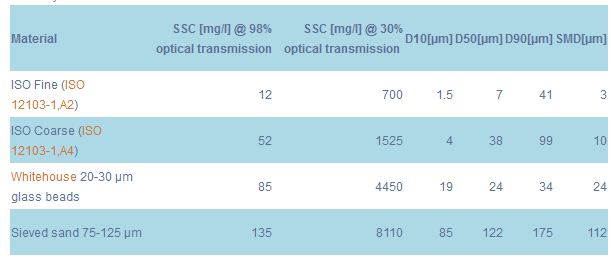
- Concentration range 30-1,900 mg/l. NOTE: Actual range is dependent on the grain-size and size distribution of the suspended particles. See table below for details and examples of concentration ranges based on measurements using ISO particle standards and easily obtained reference materials. SMD: Sauter Mean Diameter.
- Resolution < 1 mg/l
- Accuracy ± 20%
Mechanical and electrical
- Instrument Dimensions: 7” tall x 11.5” deep x 17.5” wide (17.7 cm x 29cm x 44.3cm)
- Shipping Dimensions: 31″ x 21″ x 11″
- Weight: 15 lbs (7 kgs)
- Shipping weight: 49 lbs (22 kgs)
- Internal Data Storage: 40,000+ size distributions
- Battery life: 8 hours (nominal; depends upon sampling rate)
- Battery Type: Lithium-Ion, 2 batteries at 58Wh each
- Communications: RS-232 @ 9600 baud via built-in USB-serial interface