
Model 1314 -Pre-Method
Method 1314 is a percolation column test designed to obtain liquid-solid partitioning (LSP) information as a function of liquid-solid ratio (L/S). L/S is represented as the cumulative volume of leaching solution passing through a column containing a known mass of material. For some materials, particle size reduction may be required to meet column dimension requirements and facilitate the approach to equilibrium.
This method is suitable to a wide range of granular solid materials. Example materials include industrial wastes, soils, sludges, combustion residues, sediments, construction materials, and mining wastes. This method is not suitable to monolithic materials (e.g., cement-based and stabilized materials) without particle-size reduction prior to testing.
This method is designed to provide the liquid-solid partitioning (LSP) of inorganic constituents (e.g., metals, radionuclides) and non-volatile organic constituents (e.g., polycyclic aromatic hydrocarbons (PAHs), dissolved organic carbon) in a granular solid material as a function of liquid-to-solid (LS) ratio under percolation conditions. This method is not applicable to characterize the release of volatile organic analytes.
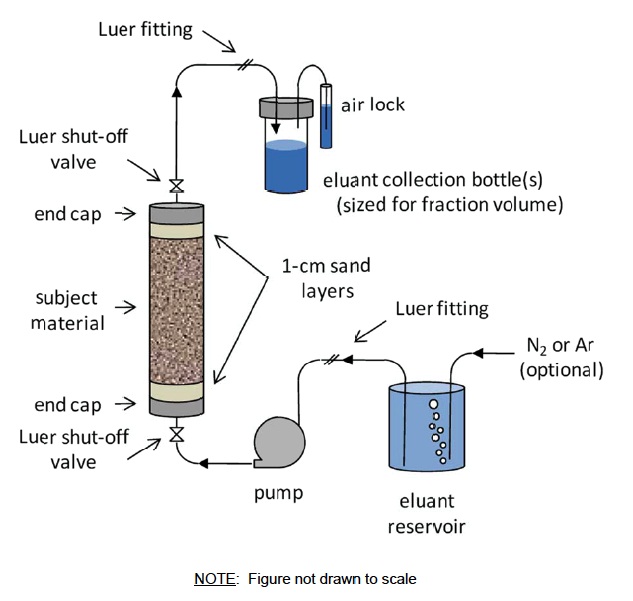
Solid material is loosely packed into a borosilicate glass column and contacted with a percolating leaching solution at low flow rate. The flow rate is maintained between 0.5-1.0 LS/day to increase the likelihood of local equilibrium between the solid and liquid phases, due to residence times longer than 1 day. Liquid is pumped in an up-flow direction to minimize channel and air entrapment. Eluates are collected at specific cumulative L/S values between L/S 0.2 and 10 mL/g-dry. Eluate concentrations and constituent cumulative release plotted as a function of L/S.
This method provides eluate solutions considered indicative of leachate under field conditions only where the field leaching pH is controlled by the alkalinity or acidity of the solid material and the field leachate is not subject to dilution or other attenuation mechanisms. The cumulative mass of constituent released over a LS ratio range may be considered an estimate of the maximum mass of that constituent to be leached under field leaching over intermediate time frames (e.g., up to 100 years) and the domain of laboratory test pH.
This method provides options for the preparation of analytical samples that provide flexibility based on the level of detail required.
Complete Characterization
For complete characterization of eluate concentration and cumulative release as a function of LS ratio, nine discrete eluate collections and analyses are required. No compositing of eluate fractions is performed for complete characterization, and all eluate fractions are analyzed.
Limited Analysis
Under a limited analysis approach, nine eluate collections and analysis of six analytical samples are required. If evaluation is based on eluate concentrations, six discrete eluate fractions are chemically analyzed. If evaluation is based on cumulative release, some eluate fractions are composited by volume-weighted averaging to create a set of six analytical samples.
Index Testing
For the determination of consistency between the subject material and previously characterized materials, nine eluate collections and analysis of three analytical samples are required. If consistency is to be determined by eluate concentrations, three discrete eluate fractions are chemically analyzed. If consistency is to be determined by cumulative release, some eluate fractions are composited by volume-weighted averaging to create a set of three analytical samples.