PSA - Mercury Vapour Generator
Mercury Vapour Generators are used to produce a known concentration of mercury for a range of applications including: Calibration of Mercury Monitors and Mercury Analysers, System integrity test, Sampling system testing for losses/drift, Spike testing Mercury Monitors and Mercury Analyser Systems, Spiking process for Catalyst removal efficiency testing.
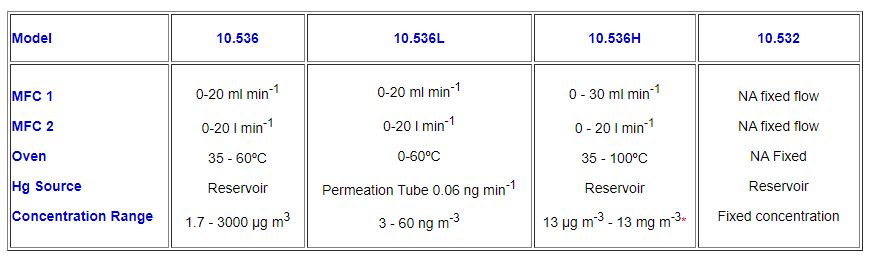
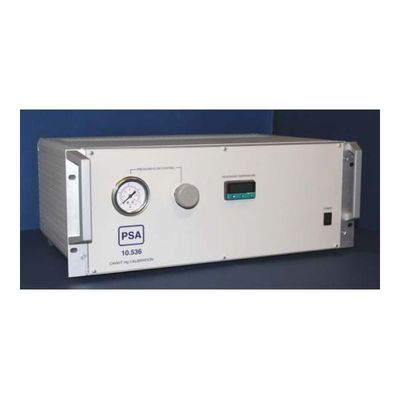
The P S Analytical 10.536 calibration gas generator can accommodate all these applications and have the capability of being extended to cover any applications which may be required in the future. It is available with the following options;
- Reservoir Type - Hg Bed or Permeation Device
- Flow and Temperature Limits - Flow rate and oven temperature variations
The PSA 10.536 series is computer controlled (via MODBUS RTU) using the PSA CavkitCalc Software or the PSA Online Software. With the PSA Online Software, the concentration can be automatically varied for different tests or multipoint calibrations and the gas flow can be fully controlled when not required.
The PSA 10.532 Mercury Vapour Generator is a fixed output and less expensive calibration device for mercury analysers. The system operates on the principle of diluting a saturated source of mercury at known temperature. A low fixed flowrate is passed across the mercury reservoir ensuring that the gas becomes saturated with mercury. The gas saturated with mercury is then diluted into the concentration range of interest. The flowrates are fixed using critical orifices to provide a fixed known concentration output. The unit also generates a Hg free zero span so that blank measurements can be performed. Rack mount, wall mount and custom options are available.
For the majority of applications, e.g. continuous emissions monitors for stack gas and removal technology testing, the levels required are in the microgram per cubic metre (µg m-3) range supported by either the standard or High-Level (H) Mercury Vapour Generators featuring a mercury reservoir are used.
For low level applications such as air monitoring where nanogram per cubic metre cubed (ng m-3) concentrations are required, the (L) Low-Level Mercury Vapour Generators (part number suffixed "L") featuring mercury permeation tubes are employed.
The standard and high-level options include a mercury reservoir. These units operate on the principle of dilution a saturated source of mercury at a known temperature. A low flow rate is passed across the mercury reservoir ensuring that the gas becomes saturated with mercury. The mercury-saturated gas is then diluted into the concentration range of interest. The flow rates are controlled using two mass flow controllers. The unit also generates a Hg free zero span so that the blank measurements can be performed. The Hg concentration can be adjusted by altering the temperature of the oven or by adjusting the reservoir or dilution flows.
The low-level options include a permeation tube in place of the mercury reservoir. With this option, the permeation rate is first established at the temperature of interest and the concentration then changed by adjusting of the dilution flow rate. Different concentration ranges can also be achieved by use of permeation tubes with different permeation rates.
Depending on the application, the mass flow controllers (MFCs) can accurately control gas flow rates and and oven temperature to provide precise Hg stream concentrations.
The standard and low-level options feature 0-20 ml min -1 flow rate range and a temperature range of 30-60oC and this allows good control over the lower flow rate concentration ranges.
The high-level options feature hotter ovens to generate higher saturated mercury concentrations as well as higher flow rates 0-30 ml min-1 to further increase the maximum mercury flow available.