- Home
- Companies
- Apoaqua Group
- Products
- Apoaqua - Model ApoPar-SWN - Pulp ...
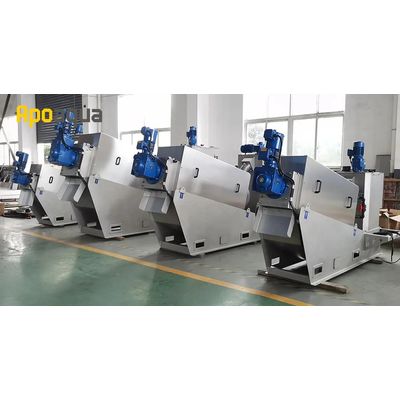
Apoaqua - Model ApoPar-SWN -Pulp Dewatering Screw Press
In the pulp drying section, when the pulp is dried to a certain extent, the biological sludge will gather and adhere to the surface of the drying cylinder. This will reduce the operating efficiency of the drying cylinder and may also cause equipment failure in the drying section.
In this regard, some researchers have conducted systematic research. The adhesion between the sludge and the stainless steel surface as well as the cohesion within the sludge are tested. This allows the sticky behavior of the biological sludge to be determined. The study found three rules:
- When the sludge solid content is less than 13%. The adhesion between the mud blocks and the stainless steel surface and the cohesion of the sludge both increase with the increase of solid content. When the solid content is higher than 13%, both the adhesion and cohesion decrease.
- Normally, the cohesive force of mud blocks is greater than the adhesive force between mud blocks and metal. Therefore, in fact, biological sludge tends to self-agglomerate into lumps rather than adhere to the smooth surface of equipment.
- The viscosity of biosludge can be reduced by using mixed wood fibers or adding fly ash from biomass boilers.
- The viscosity of biological sludge can be controlled during the drying process. This discovery could help pulp and paper companies improve drying efficiency or use biosludge to further produce biomass fuel.
ApoPar-ZTO Dewatering Screw Press Guide
The handling and disposal of biosludge has always been a problem for many pulp and paper mills, mainly due to its high moisture content, 98% water, and poor dewatering/drying characteristics. Some plants mix biosludge with native sludge that has a higher fiber content to improve the dewatering performance of the biosludge. The sludge mixture is then dewatered to 15-30% solids and disposed of in landfill (41%), incineration (54%) or on land (5%).
However, waste disposal is becoming increasingly difficult due to the rapid reduction in landfill space. Rising environmental concerns and the need to reduce water content to levels suitable for landfill or combustion in biomass boilers. Sludge treatment costs can account for up to 60% of the total operating costs of a wastewater treatment plant. For this reason, we developed the ApoPar-ZTO dewatering screw press.