VEGAPULS - Model 61 -Pulse Radar for Level
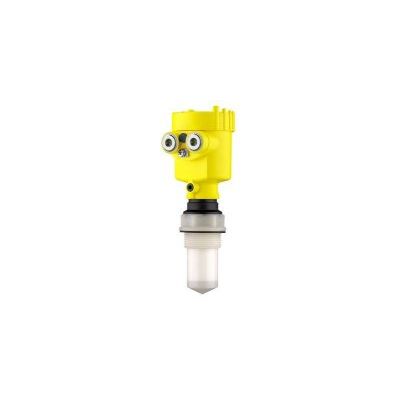
The VEGAPULS 61 is a high-frequency, economical, low maintenance radar gauge designed for measurement in installations with standard to easy process conditions.
The threaded 40 mm antenna is suitable for small vessels with corrosive liquids. With the use of the 80 mm antenna, the measurement range is 65 ft (20 m).
- 26 GHz high-frequency radar
- Loop-powered
- PVDF antenna
- Adjustment with PLICSCOM, HART handheld or PC
- Key Specifications
- -40° to 176°F (-40° to 80°C) operating temperature
- -14.5 to 29.0 psi (-1 to 2 bar) operating pressure
- +/- 2 mm accuracy
- SIL2 Qualified
Pulse
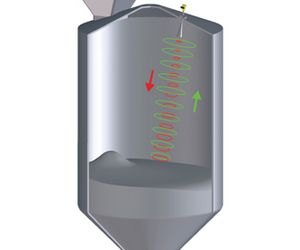
This sensor uses a high frequency K-Band that operates in a range of approximately 26 GHz. Using a focused beam angle, the sensor transmits energy in the form of short microwave pulses. These pulses are directed toward the surface of the measured product which reflects the energy back to the antenna. The high frequency range allows for precise measurement while using small antennas and compact process fittings.
Target
The amount of energy that returns to the antenna depends on the reflective properties of the material being measured. Reflectivity is determined by the dielectric constant (DK) of the measured material.
Return to Antenna
The transit time of the microwave pulse that returns to the antenna is measured and used to calculate the distance to the surface. By simply entering the vessel dimensions, a level-proportional signal can be displayed. It is not necessary to fill or empty the vessel in order to commission the VEGAPULS.
Reflectivity
Conductive products, such as water and acids, have very good reflectivity and can be measured regardless of the DK value. For non-conductive materials, the DK value alone determines the reflectivity. Materials with a low DK absorb a large portion of the microwaves transmitted by the radar sensor, thus reducing the energy reflected back to the antenna. With VEGA radar technology, it is even possible to measure materials with extremely low DK values, including liquefied gases.