


- Home
- Companies
- PV-Tools GmbH
- Products
- pv-tools - Model TLM-SCAN+ - Compact ...
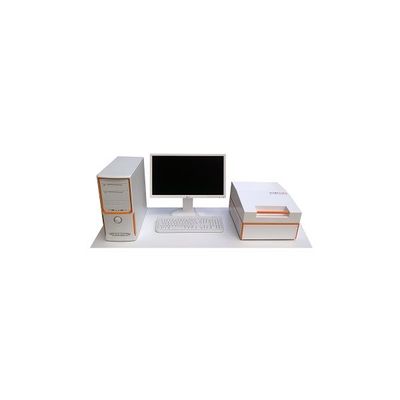
pv-tools - Model TLM-SCAN+ -Compact Instrument Measures Contact Resistivity
Contact resistivity and more: This compact instrument measures contact resistivity, finger line resistance, finger width, and finger height of a finished solar cell or on test structures. Motorized in all axes it is capable of creating maps of all these methods by pushing a single button. Four point probe heads for measuring the sheet resistance of thin diffused layers and resistivity of wafers make the TLM-SCAN+ a low-cost yet fast and high-quality four-point-probe mapper.
Contact Resistivity and Sheet Resistance
The contact resistance of the front metallization is an important contribution to the total series resistance of screen-printed solar cells. The transfer length method with a suitable test structure is the best method to separate the contact resistance from other series resistance effects. However, the contact resistance may vary considerably over the solar cell so a method to measure it with spatial resolution on the finished solar cell is necessary. The TLM-SCAN creates mappings of the contact resistivity of a solar cell that is cut into stripes with a laser or a dicing saw.
The mapping on the right demonstrates the resolution and repeatabilty as it shows the same stripe measured 14 times.
Microscope camera
This camera is used to measure the contact finger width automatically. The contour detection is helpful to verify that the margin of the fingers is properly identified. Larger dimensions can be measured using the chuck positioning and a crosshair in the image.
Surface profilometer
The surface topology is scanned using a stylus with a tip radius of 100 µm and a contact force of 10 mN. The automatically evaluated maximum elevation is displayed in the graph. The range is 100 µm, the noise less than 50 nm. This option combined with the finger width measurement is a practicable low-cost alternative to confocal microscopy.
The probe heads for the right arm are changed within seconds and recognized by the software. Available models are:
- Custom-designed probe head for TLM test patterns
- Adjustable head for solar cell stripes with finger spacing down to 1.2 mm
- Line resistance head adjustable between 22 mm and 70 mm
- Four-point-probe head for sheet resistance of diffused wafers with round tungsten-carbide tips
- Four-point-probe head for resistivity with sharp tungsten-carbide tips and larger spacing.
Stripe chuck
Holds 14 solar cell stripes, 6 - 10 mm wide and 156 mm long, with individual vacuum switches. Blank areas contact the back metal of the stripes and allow measuring the shunt conductance of each finger. A fixture to clamp the stripes vertically facilitates inspecting the sample cross-section with the microscope camera.
Glass chuck
Flat chuck for wafers that is easily cleaned such that measured samples may go back to the process line. This chuck is also used for samples with test structures for TLM and line-resistance.