


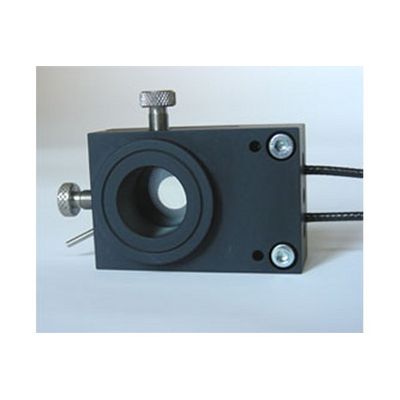
ARCoptix - Model RPC -Radial-Polarization Converter
The Radial Polarization converter (RPC)from ARCoptix is a worldwide unique device that converts a conventional linearly polarized beam into a beam that has a CONTINUOUS radial or azimuthal Polarization distribution and stable in time. As illustrated in the figure below the orientation of the Polarization vector varies spatially but locally the Polarization state is considered as linear.
Thanks to the special alignment of the liquid crystal molecules, the Polarization converter rotates locally the orientation of the linearly polarized beam. Depending of the settings of the device, we may obtain either azimuthally or a radially polarization distribution at the output as described in the figure above.
The RPC can be ordered in different options (with phase compensator and TN cell) depending of your application..
With the help of the Arcoptix RPC, LG beams and also Bessel-Gauss beam can relatively easily be generated from any laser in the VIS-NIR region (including also pulsed lasers)
By simply focalizing (here NA 0.9) an azimuthal collimated laser beam that has passed through the Polarization converter, we obtain a typically doughnut beam as shown on the left figure here below. With the help of a linear polarizer parallel to X and Y axis, we obtain respectively the the two-half-lobes spots corresponding to x-y Polarization components of the same doughnut beam (figures in the center).
By inserting an additional annular slit in the setup, we obtain focused annular azimuthal beam (here with a NA 0.9 objective) generating so a 1st order Bessel-Gauss beam or also called vortex beams (figure on the right).
The radial Polarization converter (RPC)is a nematic liquid crystal cell composed of one uniform and one circularly rubbed alignment layer. The local alignment of the LC in the Polarization converter is that of a twisted cell, with a twist angle given by the local alignment layers These twist angles are always smaller than pi/2. Due to (right-left rotation of the twist) a thin disinclination line appears in the LC cell (line in the figure below) but is unnoticeable for most types of experiments. As shown in figure above, when linearly polarized light is shining through a Polarization converter and the Polarization direction is parallel or perpendicular to the uniform alignment layer, azimuthally or radially polarized light emerges on the other side. So, by simple rotation of the entrance Polarization, the polaroptic Polarization converter can switch from radial to azimuthal Polarization distribution. A more detailed description can be found in "Stalder et. al., Optics Letters, volume 21, page 1948, published in 1996".
- Wavelength range : 350-1700 nm
- Active area : 10 mm diameter
- Transmission : better than 75% (in the VIS)
- Retarder material : Nematic Liquid-Crystal
- Substrates material : Glass bk7
- Local extinction ratio (input Intensity/ouput intensity)
- when placed between crossed polarizers : ~100 @ 633nm
- Output intensity homogenity : < 1/100 RMS variation
- Temperature range : 15° - 35°
- Safe operating limit : 500 W/cm2 CW
- 300 mJ/cm2 10 ns, visible
- 200 mJ/cm2 10 ns, 1064 nm
- Total size of the housing : 6 cm x 4 cm x 1.5 cm
When a Polarization converter is used in combination with a polarizer, the device results that can be used as Polarization axis finder (PAF). Watching the PAF a dark segment appears when the entrance Polarization is linear. The orientation of the dark segment gives the direction of the Polarization.
Inspection of birefringent materials: When placing a brefrigent material between two PAFs (two polarizers with two Polarization converters), one can analyze the birefringent properties of the sample in one glimpse (characteristic interference colors and main axis). Neither the sample nor the polarizers have to be rotated.