


- Home
- Companies
- Graetz Strahlungsmeßtechnik GmbH
- Products
- Graetz - Model RadXploreident - ...
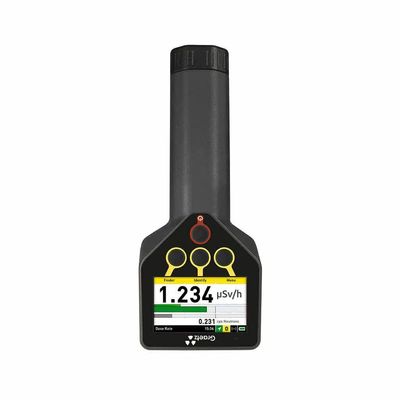
Graetz - Model RadXploreident -Radionuclide Identifier
The GRAETZ RadXplore-ident is an ultra-compact, robust and sensitive radionuclide identifier (RID) that features a wide energy range, high throughput and excellent stability with outstanding application capabilities.
- Most efficient and compact radionuclide identifier on the market
- Easy to use due to intuitive user guidance
- High connectivity and documentation capabilities through interfaces and smartphone app
- Dose rate of almost all radionuclides can be measured due to a very large energy range (10 keV to 1 GeV)
- Very high gamma sensitivity of 1,850 cps/µSv/h (Cs-137)
- Innovative and patented stabilization (Pat. US 9,864,076) based on measurement of the photoelectric quantum effect: no built-in radioactive source or LED required; gain variations are instantly and automatically compensated for
- Ultra-compact design, one-handed operation and waterproof up to 10 meters (protection class IP68)
The RadXplore-ident is designed to detect gamma, beta, neutron and cosmic radiation from natural and man-made sources, identify special nuclear, industrial, medical and natural radioactive sources, and measure X-ray and gamma radiation exposure.
During the development of the device, which is powered by a Li-Ion battery, great emphasis was placed on convenient handling as well as a high degree of user-friendliness. The result is a housing shape and weight that makes the RadXplore-ident highly ergonomic and unique: compact and operable with one hand. This is because, for the first time, it has been possible to combine a 2″ x 1″ BGO (bismuth germanate) detector with high-precision, high-speed digital electronics in an ergonomic, lightweight and waterproof aluminum housing that can be operated with one hand. The RadXplore-ident convinces in use on land, on water and even under water up to 10 meters diving depth.
- 2″ x 1″ BGO (Bi4Ge3O12) detector with superior efficiency
- Improved overall robustness with non-hygroscopic BGO detector
- Novel sourceless gain stabilization (Pat. US 9,864,076).
- High dose rate capability and neutron detection with one detector
- Nuclide identification at up to 1 million Ip/s
- Directional radiation detection
- Easy system integration through HTTP REST interface & universal API
- N42.42 data format for simple remote data transmission
- Remote control and configuration via web interface or app
- Nuclide library (> 70 nuclides) exceeds IEC-62755 and ANSI-42.34 requirements
- Energy range (gamma): 10 keVee – 1 GeVee
- Dose rate range (Cs-137): 10 nSv/h – 10 mSv/h (1 μrem/h – 1 rem/h) ±30 %.
- Dose rate range ID mode (Cs-137): 10 nSv/h – 200 μSv/h (1 μrem/h – 20 mrem/h)
- Dose rate overload range (Cs-137): 0.2 mSv/h – 500 mSv/h (0.02 rem/h – 50 rem/h)
- Maximum input count rate in ID mode 1 million cps (Cs-137)
- Gamma sensitivity 1,850 cps/μSv/h (Cs-137)
- Neutrons: According to ANSI 42.34
- Switch-on time Ready for operation in less than one minute
- Identification time Identification of 1 μCi Cs-137 in 13 s.
- Linearization Real-time linearization of gamma energy
- User interface update frequency 0.5 s
- Nuclide Library > 70 nuclides (exceeds IEC 62755, ANSI 42.34)